
TL;DR

Get garage and car supplies delivered free — and shop member deals
- Fast, free delivery on millions of items
- Access to Prime Big Deal Days deals on October 6–7
- Prime Video, Amazon Music and more included
CatEye’s AMPP1300, AMPP1700 and AMPP2200 front lights offer several output settings, with the company’s stated runtimes ranging from one to 12 hours depending on model and mode. CatEye says regulated output, charge indicators and wide-beam optics are designed to help riders match brightness to conditions and conserve battery power.
CatEye’s AMPP1300, AMPP1700 and AMPP2200 front lights offer multiple brightness modes intended to balance visibility with battery life, according to product information in a road.cc feature. The development matters to riders planning night commutes, training rides or longer events because the lights’ stated runtimes vary substantially by mode, while the rider can switch to maximum output when conditions call for it.
The top-spec AMPP2200 is rated for one hour at 2,200 lumens in Ultra Boost mode. CatEye lists 2.5 hours at 800 lumens in Middle mode, five hours at 400 lumens, and up to 12 hours at 200 lumens in Enduro mode. The feature describes the lower-output runtimes as 150%, 400% and 1,100% longer, respectively, than Ultra Boost.
The AMPP1700 is rated for 1.25 hours at 1,700 lumens in Ultra Boost, 1.75 hours at 1,300 lumens in High mode, three hours at 700 lumens, and five hours at 400 lumens. The AMPP1300 is rated for two hours at 1,300 lumens, 3.5 hours at 600 lumens in Middle mode, and 7.5 hours at 300 lumens in Low mode. These are manufacturer-stated figures as relayed by road.cc; the supplied material does not describe independent runtime testing.
On the AMPP2200, a double press of the operating button activates Ultra Boost, according to the feature. CatEye also says the lights use electronic power management to regulate output in relation to battery capacity and thermal conditions. A button indicator signals charge level: blue above 50%, orange between 50% and 20%, and red below 20%. Mode memory retains the last selected setting after the light is switched off, and a lock mode is intended to prevent accidental activation in a bag.
Runtime Choices for Night Rides
For riders who spend long periods on unlit roads or trails, a light’s maximum lumen figure does not by itself show how long it can provide useful illumination. CatEye’s listed mode options make the trade-off explicit: lower output corresponds to longer stated runtimes, while Ultra Boost remains available for demanding stretches such as descents or dark, uneven roads.
The practical value depends on the route and riding conditions. A rider may be able to use a moderate setting on familiar, well-lit sections and reserve higher output for places where extra forward visibility is needed. The charge indicator may help with monitoring remaining battery, but the supplied report does not establish how accurately riders can predict runtime in varying temperatures or real-world use.
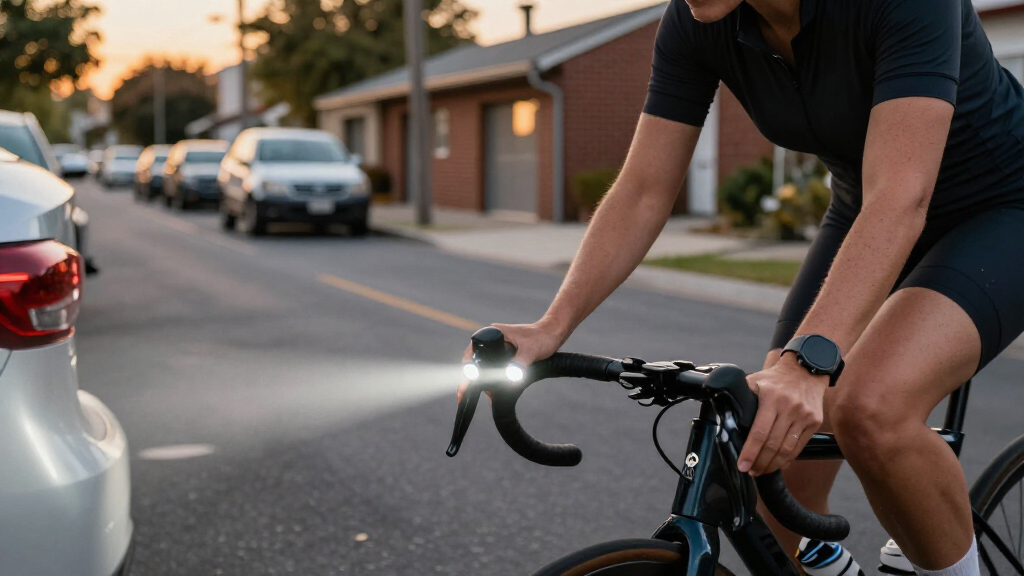
bike front light with multiple brightness modes
As an affiliate, we earn on qualifying purchases.
As an affiliate, we earn on qualifying purchases.
How CatEye Frames Light Performance
The feature sets out a product approach that treats usable brightness and runtime as linked considerations, rather than treating peak output as the only measure of performance. It says CatEye aims for regulated illumination through a selected mode instead of relying solely on a brief initial brightness peak. That description is attributable to the company’s stated approach; no comparative testing against other brands is included in the supplied material.
Each model is described as using a high-intensity white LED and CatEye OptiCube lens technology. The report says the optics spread light broadly and evenly, with side lens sections intended to make the light visible from lateral angles. That side visibility can matter at junctions and roundabouts, where traffic approaches from beyond the direct forward beam. The source excerpt ends before providing further product specifications or details.
““real-world performance for real-world rides””
— CatEye, as described in the road.cc feature
rechargeable bike light with long runtime
As an affiliate, we earn on qualifying purchases.
As an affiliate, we earn on qualifying purchases.
What Runtime Figures Do Not Show
The supplied material does not give a publication date, prices, availability, charging times, battery capacities or weight for the three models. It also does not explain the test conditions behind the stated runtime figures, such as temperature, battery age or whether the lights were tested continuously in each mode. Those details would help riders compare the estimates with their own routes and use.
The feature describes CatEye’s claims about regulated output, optics and battery management, but includes no independent measurements or side-by-side comparison. Actual runtime and perceived visibility may depend on conditions and individual use; the material does not quantify those differences.
As an affiliate, we earn on qualifying purchases.
Check Specifications Before Choosing
Riders considering an AMPP light can compare the manufacturer’s stated output and runtime for the mode they expect to use, then check current product information for price, charging details and mounting compatibility. The supplied report does not identify a forthcoming launch, test or other next milestone.
For longer rides, the listed figures suggest planning around the chosen brightness mode and checking the indicator during use. CatEye’s guidance, as presented in the feature, is to raise output when the road demands it and return to a lower setting when conditions allow.
As an affiliate, we earn on qualifying purchases.
Key Questions
How long does the CatEye AMPP2200 last?
CatEye lists runtimes of one hour at 2,200 lumens, 2.5 hours at 800 lumens, five hours at 400 lumens and up to 12 hours at 200 lumens. These are stated figures relayed in the road.cc feature.
What runtime does the AMPP1700 offer?
The stated runtimes are 1.25 hours at 1,700 lumens, 1.75 hours at 1,300 lumens, three hours at 700 lumens and five hours at 400 lumens.
How long does the AMPP1300 run?
CatEye lists two hours at 1,300 lumens, 3.5 hours at 600 lumens and 7.5 hours at 300 lumens.
How does the battery indicator work?
The button glows blue above 50% charge, orange between 50% and 20%, and red below 20%, according to the feature.
Are the runtime figures independently verified?
The supplied report attributes the runtime figures to CatEye and does not provide independent test results or the conditions used to measure them.
Source: rss
Halloween Picks
halloween
As an affiliate, we earn on qualifying purchases.