
TL;DR

Get garage and car supplies delivered free — and shop member deals
- Fast, free delivery on millions of items
- Access to Prime Big Deal Days deals on October 6–7
- Prime Video, Amazon Music and more included
Motorcycle riding gear helps protect you from impacts, abrasion, weather, and fatigue, but it cannot prevent every injury. Start with a correctly fitted, certified helmet, then add protective jacket and trousers, gloves, and motorcycle boots; check fit, condition, and relevant standards before you ride.
A short ride to the shops can still end with a scraped palm, a bruised shoulder, or worse. Motorcycle riding gear does not make you crash-proof, but it puts a protective layer between your body and the road when a ride goes wrong.
This guide helps you choose a complete gear setup, judge fit, and match clothing to heat, rain, and the kind of riding you do. You’ll learn why a helmet is only the start, what certification labels can tell you, and how to spot gear that’s ready for retirement. Think of your kit as a chain: every link needs to fit and work.
Start with a certified helmet that fits evenly snugly and stays in place when fastened.
Wear protective trousers as well as a jacket; armor and abrasion protection need to cover your legs too.
Test gear in riding posture so armor, cuffs, and coverage stay where they belong.
Choose ventilation, waterproofing, or thermal layers for your route and forecast without leaving skin exposed.
Inspect seams, fasteners, armor, and helmet condition, and follow manufacturer care and replacement guidance.
Build a full protective setup, not just a helmet
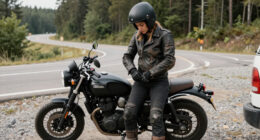
Motorcycle riding gear works best as a system: a certified helmet, protective jacket and trousers, gloves, and motorcycle boots cover more of your body than any single item can. Each piece helps manage a different risk, from a head impact to the abrasive scrape of sliding across pavement. This matters because a crash rarely confines its consequences to one body part. Gear cannot eliminate injury, but covering more of the body reduces the amount of skin and vulnerable areas left to chance.
Your helmet deserves first place in the kit, but it should not be the only item you buy. A jacket with shoulder and elbow protectors leaves your hips and knees exposed if you wear ordinary jeans. Motorcycle trousers add abrasion-resistant material and armor where a slide or impact may affect your legs. The practical implication is that upgrading one item does not compensate for a major gap elsewhere: strong torso coverage still leaves legs vulnerable if the rest of your outfit is everyday clothing.
For example, imagine commuting through town in a full-face helmet and a sturdy jacket but wearing canvas sneakers. Your head and torso have purpose-made protection, yet your ankles and feet remain vulnerable, and casual shoes can come off more easily. Gloves and boots close those gaps while also helping you keep a steady grip and feel the controls. They are not just crash equipment: secure, comfortable gear can also make it easier to operate controls consistently, especially on a long or wet ride.
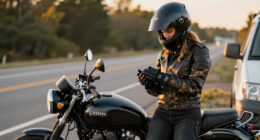
Fitted gear can stay in place better than loose street clothes, though it cannot prevent every injury. A properly fitted set helps protect riders from abrasion, impacts, weather, and fatigue. The tradeoff is that protective garments can feel heavier or warmer than casual clothing, so fit and comfort affect whether you will wear them regularly. That’s the useful idea: cover the body, secure the coverage, and pick gear you’ll actually wear every time.
- Helmet: Choose an undamaged model certified for the market where you ride.
- Jacket and trousers: Look for abrasion-resistant construction, secure closures, and correctly placed armor.
- Gloves and boots: Cover wrists, hands, feet, and ankles with riding-specific designs.
As an affiliate, we earn on qualifying purchases.
Choose a helmet that fits and carries the right certification
Motorcycle riding gear starts with a correctly fitted, certified helmet, because it protects your head and face with a purpose-built shell and liner. Look for the certification required where you ride; U.S. riders commonly check for DOT certification, while ECE 22.06 is used in many markets outside the United States. Certification gives you a meaningful baseline: it indicates that a helmet has been assessed against a defined standard, rather than merely being styled or marketed for motorcycling.
A helmet should feel evenly snug around your head without painful pressure points. Fasten the strap and try to roll or lift the helmet gently: it should not move freely or slide off. Helmet shapes vary, so one brand may pinch your forehead while another fits like it was made for you. Try several models in person when possible, and wear each for a few minutes before deciding. Fit matters because a loose helmet can shift during a crash, while a painful one may distract you or discourage regular use. Do not assume a larger size is more comfortable if it moves around.
A full-face helmet covers your chin and face, unlike an open-face design, which leaves more of that area exposed. That extra coverage may suit a commuter who rides in traffic and a weekend rider heading out on open roads alike, provided the helmet fits and meets the relevant standard. The tradeoff is personal preference: coverage, ventilation, noise, and ease of putting a helmet on can feel different from one design to another. Recent ECE 22.06 testing adds impact scenarios and assessments of some accessories compared with the earlier 22.05 standard; check the label rather than judging by graphics or price.
Replace a helmet after a significant impact, even if you cannot see damage, and follow the manufacturer’s guidance for routine replacement. A dropped helmet is not automatically ruined, but a hard impact can compress the inner liner without leaving an obvious mark. If a crash involves head impact or you’re unsure about damage, ask the manufacturer or a qualified retailer for guidance. This is why a clean exterior is not enough to judge a helmet’s condition: the component that manages impact may be hidden. A helmet that looks pristine on a shelf may still need to retire.
Fit first, certification second, styling third. A premium-looking helmet that moves around your head is the wrong helmet for you.
motorcycle protective jacket and trousers
As an affiliate, we earn on qualifying purchases.
As an affiliate, we earn on qualifying purchases.
Check clothing fit before you trust the armor
Motorcycle riding gear protects best when its armor covers the intended joints and stays there as you move. A protector that shifts away from your elbow or knee can leave the very spot it is meant to cover exposed. Look for secure closures, strong seams, and armor at the shoulders, elbows, hips, and knees; back or chest protection can add coverage. The key is not simply having protectors sewn into a garment, but having them positioned where they can do their job when your riding posture differs from how you stand in a shop.
Try a jacket in your riding posture, not just standing straight in a shop. Bend your elbows, reach for imaginary handlebars, and crouch as you would on your bike. Sleeves should not pull high, the back should not ride up, and the armor should sit over the joints rather than beside them. Trousers deserve the same test: sit on a chair with your knees bent and check that the knee protectors remain in position. This test can expose problems that a simple size check misses, such as cuffs that reveal skin only when your arms reach forward.
Recognized ratings can help you compare protectors. In Europe, EN 1621 is a standard family for impact protectors; check which rating applies to the component and garment you are buying. A label is useful, but it cannot fix poor fit. Ratings tell you about a tested component under specified conditions; they do not guarantee that it covers your joints properly, stays in place, or protects every part of your body. For instance, a jacket that feels perfect upright may leave a strip of wrist bare when you reach forward to the bars.
Leather and modern textiles each have tradeoffs. Leather is widely used for abrasion resistance, while textile garments can offer practical weather features and ventilation. Neither material wins automatically: construction, seams, armor, fit, and testing all matter. A tightly fitted garment may keep protectors in place but feel restrictive, while a looser or more versatile garment may be comfortable across changing conditions but needs careful adjustment to prevent movement. Choose the jacket and trousers you can wear comfortably for a full ride, and make sure their closures keep coverage where it belongs.
- Check that armor stays over your joints in riding posture.
- Inspect seams, zippers, cuffs, and waist connections for secure construction.
- Pair a jacket with protective trousers rather than treating it as full-body coverage.
As an affiliate, we earn on qualifying purchases.
Match gloves, boots, and visibility to the ride
Gloves and motorcycle boots protect the hands, feet, and ankles while helping you control the bike. Gloves should fit securely, cover the wrists, and let you operate the clutch, brake, and switches without bunching. Boots should fasten firmly, grip the ground, and add reinforcement around vulnerable areas. That balance matters: overly bulky or poorly fitting gloves can interfere with feel and control, while a loose boot may shift or come off when you need stable footing.
That last point becomes obvious when you stop on a sloped driveway or put a foot down on loose gravel. Soft running shoes may feel comfortable in the garage, but a riding boot gives your ankle more coverage and a sole designed for stable contact. On a long day, a boot that rubs or a glove that wrinkles across the palm can become a distraction, so test both while seated and reaching for the controls. The tradeoff is that more protective footwear may feel stiffer at first; choose a pair that allows the movement you need without sacrificing secure coverage.
Visibility matters too. Bright panels and reflective details can help other road users notice you, especially at dusk or in rain, when a dark jacket can disappear against wet asphalt. They do not grant you right of way, but they can make your outline easier to pick out. Visibility is therefore a useful extra layer, not a substitute for leaving space, choosing a visible position, and assuming other road users may not see you.
Wind noise deserves attention on longer rides. Earplugs designed for riding can reduce wind noise while allowing important sounds through; check local rules and choose products that preserve situational awareness. Reducing noise can make a ride less tiring, but blocking too much sound can interfere with awareness, so suitable products and a proper fit matter. A useful example: a commuter who rides a fast, exposed route may reach the office less fatigued with suitable earplugs, gloves, and boots than with casual gear chosen only for convenience.
- Gloves: Secure wrist closure, coverage, and a grip that does not bunch.
- Boots: Firm fastening, useful sole grip, and ankle protection.
- Visibility: Reflective or bright details can help in low light.
As an affiliate, we earn on qualifying purchases.
Dress for heat, rain, and the miles you ride
The right gear matches your weather and riding style without asking you to give up protection. Ventilated garments can help in heat, waterproof layers or membranes can help in rain, and thermal layers can improve comfort in cold. Comfort is more than a luxury: if gear feels unbearable, you may leave it at home. At the same time, a feature that works in one condition can be a drawback in another, so think about the whole trip rather than a single moment.
Picture a summer commute that starts at 7 a.m. and ends in afternoon traffic. A ventilated jacket and trousers can move air through the ride, while a moisture-wicking base layer can feel less clammy than cotton. Take hydration breaks in hot conditions, and do not mistake exposed skin for a cooling strategy: sun, wind, and road debris come with that choice. Ventilation can make protective clothing more tolerable, but airflow may be less helpful when temperatures drop or rain arrives; removable layers can help manage those changes without removing the protective outer garment.
Touring, commuting, track riding, and off-road riding call for different designs. A touring rider may value waterproof storage and layers for changing temperatures; a track rider may need gear built for a close fit and track use. If you ride in frequent showers, a waterproof layer that fits over or under your riding suit can keep you focused instead of shivering inside damp cuffs. Each choice involves a tradeoff: waterproofing can add warmth or bulk, while highly ventilated gear may be uncomfortable in cold rain. Prioritize the conditions you face most often, then carry adaptable layers for less predictable weather.
Airbag vests and jackets add another option, not a replacement for the basics. Systems differ in coverage, activation, maintenance, and cost; some use a tether, while others use electronic sensors. Before buying one, compare the manufacturer’s specifications and instructions, including how to reset or service the system. These differences affect how readily the system fits into your routine: a system that is inconvenient to connect, recharge, or maintain may be less useful if it is not worn as directed. If you often ride alone on long routes, a system’s setup and upkeep may matter as much as its feature list.
| Ride or condition | Gear feature to prioritize | Practical example |
|---|---|---|
| Hot commuting | Ventilation and a moisture-wicking layer | Mesh panels with protective construction |
| Wet touring | Waterproofing and easy layering | Rain layer over a riding suit |
| Cold mornings | Thermal layers and wind blocking | Warm base layer under a secure jacket |
| Extra torso coverage | Compatible airbag system | Check activation, coverage, and service needs |
Use this five-step check before you buy or ride
A quick, repeatable gear check helps you catch poor fit and damage before they become a roadside problem. You do not need a workshop or a long checklist. Spend a few focused minutes checking certification, coverage, closures, condition, and comfort in riding posture. Doing these checks consistently also helps you notice changes—such as a stretched closure or shifted armor—that may be easy to miss if you only inspect gear when something goes wrong.
- Read the labels. Confirm that the helmet and protectors meet standards relevant to your location, such as DOT or ECE 22.06 for helmets and EN 1621 ratings for some protectors. Labels help you compare products, but check what the particular standard applies to rather than assuming one marking describes every feature of the garment.
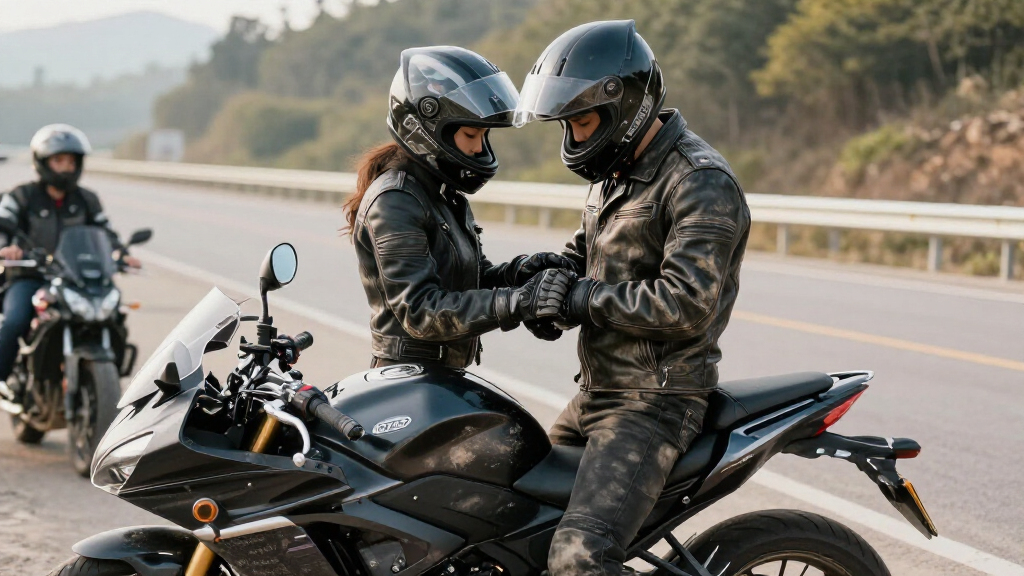
- Try the full setup together. Put on helmet, jacket, trousers, gloves, and boots; sit as you would on your bike and check that cuffs and waist connections do not expose skin. Gear can fit well as separate pieces yet leave gaps when combined, so test the actual layers and closures you plan to ride in.
- Move through riding motions. Reach for the bars, bend your knees, and operate imaginary controls. Armor should stay put, and gear should not restrict movement. A garment that feels secure only while standing may shift or bind once you adopt your riding posture.
- Inspect wear and closures. Look for damaged seams, worn fasteners, cracked armor, and helmet damage. Follow care instructions, since unsuitable washing or storage can affect materials and protective components. A small defect in a closure or seam can affect how well the garment stays in place, so do not treat cosmetic appearance as the only measure of condition.
- Match the forecast and route. Add layers or rain protection for the day, then make sure the extra layer does not displace armor or interfere with your controls. The goal is not simply to stay warm or dry; it is to manage comfort without compromising fit or movement.
For example, a rider buying trousers online may check the waist size and miss knee armor that sits too low when seated. A two-minute crouch test can reveal the problem before the first ride. If a zipper fails, a seam opens, or a protector cracks, do not assume it will perform as designed; contact the manufacturer or replace the affected item. A repair may be appropriate in some cases, but follow the maker’s advice so that a fix does not weaken a protective feature.
Price alone is a poor shortcut. Compare fit, construction, standards, warranty, comfort, and replacement-part availability. A mid-priced jacket that fits your shoulders and stays closed can be a better choice than a costly model that rides up every time you lean forward. The best value is not necessarily the lowest price: it is gear whose useful protection and comfort make you likely to keep it in good condition and wear it consistently.
Frequently Asked Questions
What is the most important piece of motorcycle gear?
A properly fitted, certified helmet is the priority, but it is not a complete setup. Add a protective jacket and trousers, gloves, and motorcycle boots to cover more of your body.
Is a full-face helmet safer than an open-face helmet?
A full-face helmet covers the chin and face, so it provides more coverage than an open-face design. Choose a certified helmet that fits correctly and suits your riding, rather than relying on style alone.
How tight should a motorcycle helmet feel?
It should feel evenly snug without painful pressure points, and it should not roll or lift easily when fastened. Try different helmet shapes because brands can fit differently.
When should I replace my helmet?
Replace a helmet after a significant impact or when it is damaged, even if you cannot see damage. For routine aging, follow the manufacturer’s replacement guidance; no single lifespan applies to every helmet and use pattern.
Is leather safer than textile motorcycle gear?
Neither material is automatically safer in every situation. Protection depends on construction, seams, fit, armor, and testing; leather is common for abrasion resistance, while textile gear often offers weather versatility.
Can I wear motorcycle gear in hot weather?
Yes. Choose ventilated riding garments and a moisture-wicking layer, and take hydration breaks. Avoid swapping protective clothing for ordinary lightweight clothes that leave your skin exposed.
Are motorcycle airbag vests worth buying?
An airbag vest or jacket can add torso protection, but systems vary in coverage, activation, cost, and maintenance. Compare the manufacturer’s instructions and treat an airbag as an addition to—not a replacement for—your helmet and protective clothing.
Conclusion
Buy for fit, certified protection, and coverage before you buy for color or price. A helmet, jacket, trousers, gloves, and boots should work together and feel comfortable enough that you wear them on the short ride as well as the weekend run.
Check your kit before your next ride. The best gear is the gear that stays in place when the road turns rough—and is already on you when the unexpected arrives.
Halloween Picks
halloween
As an affiliate, we earn on qualifying purchases.