TL;DR

Get business pricing on garage and car supplies
- Business-only prices and quantity discounts
- Tax-exempt purchasing
- Multiple users, one account, clear invoices
Cycling Weekly has profiled a 1981 Motobécane raced by French professional Jean-Luc Vandenbroucke, highlighting its metallic blue paint and largely French-made components. The article places the bike within a period when established French manufacturers faced growing overseas competition and new materials.
Cycling Weekly has profiled a 1981 Motobécane raced by French professional Jean-Luc Vandenbroucke, drawing attention to its metallic blue paintwork and collection of largely French components. The feature presents the bike as an example of Motobécane’s racing-era identity, while placing the marque among French manufacturers facing a changing bicycle industry in the early 1980s.
The bike is described as a size 60cm model ridden midway through Vandenbroucke’s time with the La Redoute–Motobécane team. The source says he won prologues for the team between 1980 and 1983. Its account identifies the bicycle as an ’81 model, although it does not provide a race-by-race history or establish which particular events this example was used in.
Current owner Richard Hoddinott, identified as the owner of vintage cycling site The Velo Pages, describes the bicycle as “so wonderfully Gallic.” The feature lists a 53-tooth Stronglight chainset, Simplex derailleurs and shifters, a Sachs Maillard six-speed cassette, Maillard 700 hubs and Mavic Super Champion rims. It says the Cinelli cockpit, Selle Italia saddle and Weinmann 400 brakes came from outside France.
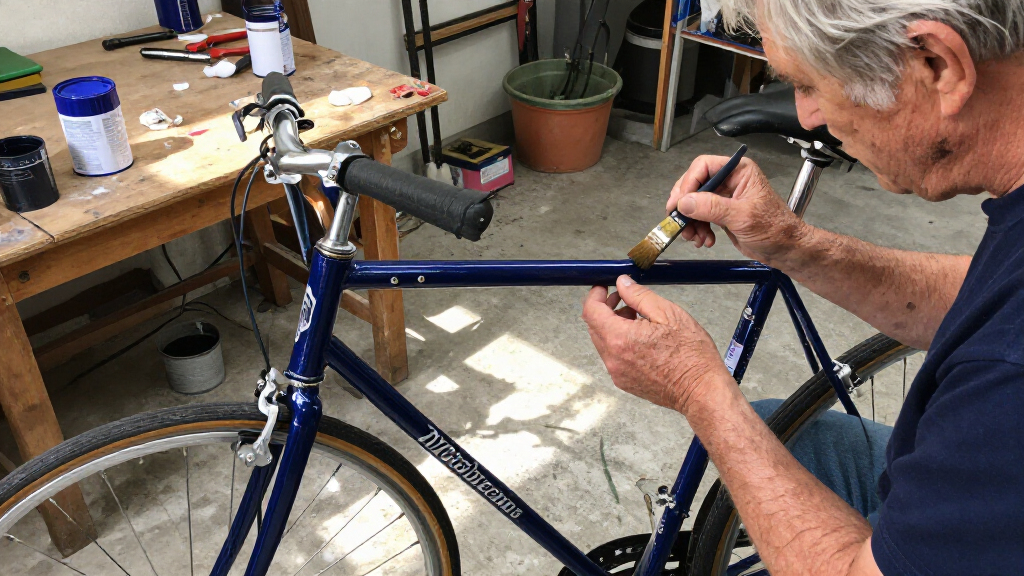
The report also emphasizes the bike’s deep blue flam metallic paint, chromed forks and rear triangle, and a Cinelli microfusion fork crown. These are descriptions of the example featured, rather than a claim that every Motobécane from the period had the same finish or specification. Hoddinott is described as a collector who keeps his bikes in original condition; the source does not provide a separate appraisal or authentication report for this bicycle.
A French Racing Bike in Transition
The profile matters as a record of a period when French racing brands and component makers were under pressure. Cycling Weekly says Motobécane, Peugeot, Gitane and Mercier were still winning races in the early 1980s, but that their prominence faced challenges from overseas competition and the arrival of carbon fibre. It also says French component firms including Simplex, Huret, Mafac and Maillard encountered similar difficulties.
The bike makes that industrial history tangible through its parts list: many components came from French manufacturers whose names became associated with the country’s cycling industry. Its carefully described finish also shows how a bicycle can be valued as both a racing machine and a designed object. The feature is a historical profile, not evidence of a current product launch, sale or change in Motobécane’s ownership.
As an affiliate, we earn on qualifying purchases.
From Motobécane to Modern French Racing
Motobécane belonged to an older generation of French bicycle makers. In the source account, the company’s bikes remained part of professional racing in the early 1980s, even as competitive and technological pressures threatened established brands. Cycling Weekly describes the decade as a turning point for Motobécane and its compatriots, but does not give precise dates for each company’s closure or explain the circumstances of each business in detail.
Vandenbroucke later retired from racing and built a career as a directeur sportif at Lotto, according to the feature. The report also notes that French cycling businesses have continued to appear in professional racing, naming Look, Lapierre and Van Rysel. That later presence provides a useful contrast with the era of the bike, but does not mean the modern companies are direct continuations of Motobécane.
“It’s so wonderfully Gallic.”
— Richard Hoddinott, current owner of the bicycle and owner of The Velo Pages, as quoted by Cycling Weekly
As an affiliate, we earn on qualifying purchases.
What the Profile Does Not Establish
The supplied article does not identify the exact races in which this particular 1981 bicycle was ridden, provide a chain of ownership, or set out independent documentation confirming its full provenance. It identifies the bike as Vandenbroucke’s ride during his La Redoute–Motobécane years, but the details available here do not establish whether it was used in a specific prologue or victory.
The source also offers no current valuation, sale information or technical inspection. Its account of pressure on French manufacturers is broad: it does not quantify the effects of overseas competition or carbon fibre, or give a company-by-company timeline. Those points should be treated as the feature’s historical framing, not as a detailed economic study.
As an affiliate, we earn on qualifying purchases.
No Further Development Reported
The supplied material describes a published cycling-history feature rather than an ongoing event. It gives no announcement of a sale, public exhibition or planned restoration, and does not indicate that Hoddinott intends to change the bike’s original condition. The next available information would depend on further reporting from Cycling Weekly or the owner, particularly any additional provenance or race records.
As an affiliate, we earn on qualifying purchases.
Key Questions
What bike is featured in the report?
It is a size 60cm, 1981 Motobécane associated with professional rider Jean-Luc Vandenbroucke and the La Redoute–Motobécane team.
What makes this Motobécane distinctive?
The feature highlights its deep blue metallic paint, chromed fork and rear triangle, and a parts specification made largely from French components, including Simplex, Stronglight, Maillard and Mavic equipment.
Who owns the bicycle now?
Cycling Weekly identifies Richard Hoddinott, owner of The Velo Pages, as the current owner. The supplied report does not provide further details about when or how he acquired it.
Did Vandenbroucke race this exact bike in a particular event?
The feature connects the bicycle to Vandenbroucke’s La Redoute–Motobécane period, but the supplied material does not name a specific race or provide event records establishing its use in one.
What does the article say about French cycling brands?
It says Motobécane and other established French makers remained active in racing in the early 1980s, while facing overseas competition and new materials. It also points to later professional-racing brands including Look, Lapierre and Van Rysel.
Source: rss
Halloween Picks
halloween
As an affiliate, we earn on qualifying purchases.