For most riders, I’d start with the Drift Ghost XL Pro: its 4K recording and waterproof action-camera design make it a strong all-round choice for capturing rides. The Insta360 GO 3S suits riders who want a tiny in-helmet POV camera, while the MUFU V40S is a better fit for those prioritizing a dual-camera dash-cam setup. Motorcycle helmet cameras differ most in mounting style, recording time, stabilization, and whether they also handle intercom or incident-recording duties. A compact camera is easier to position, but may offer different battery and control tradeoffs than a dedicated dash cam or headset-camera combination. Read on for the full breakdown and the pick that best matches your riding routine.

Get business pricing on garage and car supplies
- Business-only prices and quantity discounts
- Tax-exempt purchasing
- Multiple users, one account, clear invoices
Complete the kit


Key Takeaways
- The Drift Ghost XL Pro is my all-round lead for riders who want a dedicated, waterproof action camera with 4K recording rather than a camera bundled into a communication system.
- The Insta360 GO 3S prioritizes low-profile POV capture; its tiny form is a more natural fit for discreet in-helmet footage than larger action-camera bodies.
- The MUFU V40S and LKT DB5S take a different approach with dual-camera coverage, which can suit incident documentation better than a single forward-facing action camera.
- Headset-camera models combine jobs, not necessarily priorities: the BTQILEYOO Q28 and FreedConn R1 Plus pair recording with Bluetooth or intercom functions, making them relevant when communication matters as much as footage.
- Resolution alone does not settle the choice: stabilization, mounting position, runtime, weather protection, and ease of starting a recording all affect whether a camera works for a rider’s actual trips.
| Drift Ghost XL Motorcycle Action Camera |  | Best for Long Rides | Resolution: 1080p (FHD) | Battery life: Up to 9 hours | Water resistance: IPX7 waterproof | VIEW LATEST PRICE | See Our Full Breakdown |
| BTQILEYOO Q28 Motorcycle Bluetooth Headset with 1080p Camera |  | Best Headset-and-Camera Combo | Video resolution: 1080p | Frame rate: 30 FPS | Lens angle: 120° | VIEW LATEST PRICE | See Our Full Breakdown |
| Drift Ghost XL 1080p Waterproof Action Camera |  | Best for Ride Documentation | Video resolution: 1080p | Still photo resolution: 12 MP | Battery capacity: 3000 mAh | VIEW LATEST PRICE | See Our Full Breakdown |
| Sixmou i3 4K Thumb-Size Action Camera with 64GB Card |  | Best Compact 4K Pick | Video resolution: Up to 4K | Weight: 35.7 g | Dimensions: 0.7 × 1.1 × 2.5 in | VIEW LATEST PRICE | See Our Full Breakdown |
| 4K Mini Body Camera with 6-Axis EIS Stabilization |  | Best for Stabilized Footage | Video resolution: 4K at 30 fps | Image stabilization: 6-axis electronic image stabilization | Weight: 35 g | VIEW LATEST PRICE | See Our Full Breakdown |
| AKASO Brave 4 4K Action Camera | 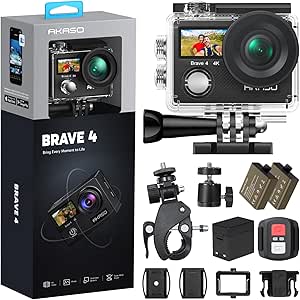 | Best Value for Mounting Flexibility | Video resolution: Up to 4K at 30 fps | Photo resolution: 20 MP | Viewing angles: 170°, 140°, 110°, and 70° | VIEW LATEST PRICE | See Our Full Breakdown |
| Drift Ghost XL Pro 4K Waterproof Action Camera |  | Best for Long Rides | Video resolution: Up to 4K | Recording time: Up to 7 hours at 1080p or 4.5 hours at 4K | Lens rotation: 300° | VIEW LATEST PRICE | See Our Full Breakdown |
| AKASO EK7000 4K Action Camera with Wi-Fi, EIS, Waterproof Case, and Remote |  | Best Entry-Level 4K Pick | Video resolution: 4K at 30 fps; 2.7K at 30 fps | Photo resolution: 20 MP | Stabilization: Electronic image stabilization | VIEW LATEST PRICE | See Our Full Breakdown |
| Insta360 GO 3S Motorcycle In-Helmet POV Bundle, 128GB |  | Best In-Helmet POV Bundle | Video resolution: 4K | Storage: 128 GB | Stabilization: FlowState | VIEW LATEST PRICE | See Our Full Breakdown |
| FreedConn R1 Plus Motorcycle Helmet Intercom with 1080p Camera |  | Best Camera-and-Intercom Combo | Camera: 1080p HD with 120-degree lens | Intercom range: Up to 3,280 feet | Rider capacity: Up to 6 riders | VIEW LATEST PRICE | See Our Full Breakdown |
| LKT DB5S Dual-Lens Motorcycle and Bicycle Camera |  | Best for Front-and-Rear Coverage | Front resolution: 2K | Rear resolution: 1080p | Image sensor: Sony | VIEW LATEST PRICE | See Our Full Breakdown |
| MUFU V40S Motorcycle Dash Cam with Dual 2K Cameras |  | Best for Longer Dual-Camera Rides | Camera resolution: 2K front and rear | Battery capacity: 4000mAh | Water resistance: IP66 | VIEW LATEST PRICE | See Our Full Breakdown |
| DJI Osmo Action 4 Essential Combo Waterproof Action Camera |  | Best Premium Action-Camera Footage | Sensor: 1/1.3-inch | Video resolution: Up to 4K | Maximum frame rate: 120 fps at specified resolutions | VIEW LATEST PRICE | See Our Full Breakdown |
| motorcycle helmet camera | Video resolution | Connectivity |
|---|---|---|
| Drift Ghost XL Motorcycle Acti | — | Bluetooth and Wi-Fi |
| BTQILEYOO Q28 Motorcycle Bluet | 1080p | — |
| Drift Ghost XL 1080p Waterproo | 1080p | Bluetooth and Wi-Fi |
| Sixmou i3 4K Thumb-Size Action | Up to 4K | Wi-Fi |
| 4K Mini Body Camera with 6-Axi | 4K at 30 fps | 2.4 GHz Wi-Fi and Bluetooth |
| AKASO Brave 4 4K Action Camera | Up to 4K at 30 fps | Wi-Fi and HDMI |
| Drift Ghost XL Pro 4K Waterpro | Up to 4K | USB and Wi-Fi |
| AKASO EK7000 4K Action Camera | 4K at 30 fps; 2.7K at 30 fps | — |
| Insta360 GO 3S Motorcycle In-H | 4K | — |
| FreedConn R1 Plus Motorcycle H | — | — |
| LKT DB5S Dual-Lens Motorcycle | — | — |
| MUFU V40S Motorcycle Dash Cam | — | USB and Wi-Fi |
| DJI Osmo Action 4 Essential Co | Up to 4K | — |
More Details on Our Top Picks
Drift Ghost XL Motorcycle Action Camera
The Ghost XL makes the strongest case for riders who want a camera running through a full day rather than the highest resolution. Its up to 9-hour battery life, IPX7 waterproofing, and loop-recording dash cam mode suit long commutes and touring in changeable weather. The rotating lens helps keep the horizon level when the camera is mounted at an unusual angle, a useful helmet-specific advantage over the fixed-angle Sixmou i3. The tradeoff is that this model records only 1080p and has no image stabilization, so rough-road footage may look less steady than footage from the 4K Mini Body Camera with six-axis EIS. It also needs a separate MicroSD card. I’d choose it for endurance and weather protection, not for polished, highly detailed action footage.
Pros:- Up to 9 hours of continuous recording supports long rides
- IPX7 waterproof design suits rain and wet riding conditions
- Rotating lens helps level footage across different mounting positions
- Loop recording and dash cam mode support ride documentation
Cons:- 1080p resolution offers less detail than the 4K options in this roundup
- No image stabilization can leave rough-road footage visibly shaky
- MicroSD card is required and not included in the listed accessories
Best for: Touring riders and daily commuters who want long recording time, wet-weather protection, and loop recording without frequent battery changes
Not ideal for: Riders prioritizing stabilized, high-detail footage or those who do not want to buy a MicroSD card separately
- Resolution:1080p (FHD)
- Battery life:Up to 9 hours
- Water resistance:IPX7 waterproof
- Lens:Fisheye lens with rotation
- Image stabilization:None
- Connectivity:Bluetooth and Wi-Fi
- Storage:MicroSD card required
- Weight:0.13 kg
Our verdict“Choose the Ghost XL if long runtime and waterproofing matter more to you than 4K detail or stabilized footage.”
BTQILEYOO Q28 Motorcycle Bluetooth Headset with 1080p Camera
The Q28 is less a dedicated action camera than a helmet communication system with recording built in. That combination makes it a practical pick for riders who want Bluetooth calls, music, and 1080p footage from one helmet-mounted unit instead of adding a separate camera. Its included 32 GB TF card means recording can start without an extra storage purchase, and the 120° lens gives a broad view of the road. Against the Drift Ghost XL, the Q28 gives up runtime—up to 6.5 hours of video versus the Drift’s stated 9 hours—but adds headset functions and USB-C charging. Its IP66 rating is also less protective than the Drift’s IPX7 rating. I’d pick it for integrated riding communication, not for the longest or most weather-resilient recording sessions.
Pros:- Combines a 1080p camera with a Bluetooth helmet headset
- Includes a 32 GB TF card and supports cards up to 256 GB
- Offers up to 50 hours of music playback
- USB-C charging, automatic call answering, and voice-assistant support add riding convenience
Cons:- Video recording is limited to up to 6.5 hours per charge, shorter than the Drift Ghost XL
- IP66 protection is below the IPX7 rating of the Drift Ghost XL models
- The camera is limited to 1080p video
Best for: Riders who want helmet-mounted video alongside calls, music playback, and voice-assistant access in a single device
Not ideal for: Tourers needing the longest continuous recording time or riders seeking a camera with stronger stated water protection
- Video resolution:1080p
- Frame rate:30 FPS
- Lens angle:120°
- Video recording time:Up to 6.5 hours
- Music playback time:Up to 50 hours
- Water resistance:IP66
- Bluetooth:Version 5.3
- Storage:32 GB TF card included; supports up to 256 GB
- Charging port:USB-C
Our verdict“Pick the Q28 if you want one helmet device for basic video and everyday Bluetooth communication.”
Drift Ghost XL 1080p Waterproof Action Camera
This Ghost XL variant is aimed at riders who want a camera to double as a simple ride-recording system. Its dash cam loop recording and event footage protection can help preserve clips around a sudden impact, while the 140° field of view captures more of the road than the Q28’s 120° lens. The stated up to 9-hour runtime and IPX7 waterproofing also make it a stronger fit for long, wet rides than the Sixmou i3, whose 4K recording time is much shorter and whose camera needs a case for water protection. The main compromise is resolution: it records at 1080p, with no higher video mode listed, and stabilization is not specified in the provided details. Choose this for dependable documentation, not maximum image detail.
Pros:- Up to 9 hours of recording supports long rides
- IPX7 water resistance is suited to wet conditions
- Loop recording and event detection help protect footage around sudden impacts
- 140° field of view captures a broad view of the ride
Cons:- Video resolution is limited to 1080p in the supplied product data
- Image stabilization is not listed, leaving shake performance unclear
- The supplied details do not state whether a memory card is included
Best for: Commuters and touring riders who want wide-angle, weather-resistant footage with loop recording and impact-related clip protection
Not ideal for: Riders who want 4K video, or buyers who need confirmed image stabilization for bumpy-road footage
- Video resolution:1080p
- Still photo resolution:12 MP
- Battery capacity:3000 mAh
- Battery life:Up to 9 hours
- Water resistance:IPX7
- Lens field of view:140°
- Sensor:CMOS
- Connectivity:Bluetooth and Wi-Fi
- Recording mode:Dash Cam Mode with loop recording and event detection
Our verdict“Choose this Ghost XL if ride documentation and long, weather-resistant recording matter more than 4K footage.”
Sixmou i3 4K Thumb-Size Action Camera with 64GB Card
At 35.7 g, the i3 is the compact choice for riders who want a small camera with 4K capture and a supplied 64 GB card. Its light body and range of mounting accessories suit helmet or gear placement where a larger unit may feel intrusive. Compared with the Drift Ghost XL, it offers up to 4K resolution but sacrifices the Drift’s long runtime and built-in IPX7 protection: the i3 lasts up to 90 minutes in 4K, and the camera itself is not waterproof without its case. It can record while charging, which may help on longer rides if a power source and cable are practical, though that setup is less tidy on a helmet. I’d favor it for short rides and compact mounting, not all-day rain exposure.
Pros:- 35.7 g body keeps the camera lightweight on a helmet or gear
- Records up to 4K and includes a 64 GB microSD card
- Supports recording while charging
- Included case supports underwater use to 40 m
Cons:- 4K recording lasts up to 90 minutes per charge
- The camera itself is not waterproof without the included case
- Charging while recording can require a cable and power source near the mount
Best for: Riders seeking a very lightweight 4K POV camera for shorter rides, with included storage and flexible mounting accessories
Not ideal for: Long-distance riders who need hours of untethered recording or riders who want water protection without a bulky case
- Video resolution:Up to 4K
- Weight:35.7 g
- Dimensions:0.7 × 1.1 × 2.5 in
- Battery capacity:800 mAh
- Battery life:Up to 90 minutes in 4K; 150 minutes in 1080p
- Waterproofing:Up to 40 m with included case; camera alone is not waterproof
- Storage:64 GB microSD card included
- Connectivity:Wi-Fi
- Recording while charging:Supported
Our verdict“Pick the i3 for lightweight 4K recording on shorter rides, provided you can manage its limited runtime and case-dependent water protection.”
4K Mini Body Camera with 6-Axis EIS Stabilization
The defining advantage here is six-axis electronic image stabilization, a feature that gives this small 4K camera a clearer purpose for helmet footage on uneven roads. At 35 g, it is close in weight to the Sixmou i3, but adds a built-in screen for preview and playback; that makes framing easier without relying solely on a connected phone. It also offers 4K at 30 fps, loop recording, and a stated runtime of up to 150 minutes, though the recording conditions behind that figure are not specified. Unlike the Drift Ghost XL, this model is not described with an IPX7 rating; water use depends on its included case. I’d favor it over the i3 when stabilization matters more than a longer 4K session, but check the case setup before riding in rain.
Pros:- Six-axis electronic stabilization is designed to reduce camera shake
- Records 4K video at 30 fps
- 35 g body and built-in screen support compact mounting and quick framing checks
- Includes a waterproof case and multiple mounts, including a helmet mount
Cons:- Up to 150 minutes of battery life is listed without recording-condition details
- Water protection depends on the included case rather than a stated camera-only rating
- The display size differs between the description and specifications
Best for: Riders who want a lightweight 4K camera with built-in stabilization and a screen for checking framing before a ride
Not ideal for: Riders needing proven long-duration recording, exposed-camera waterproofing, or a clearly stated runtime under specific recording conditions
- Video resolution:4K at 30 fps
- Image stabilization:6-axis electronic image stabilization
- Weight:35 g
- Dimensions:0.77 × 1.12 × 2.62 in
- Battery life:Up to 150 minutes
- Display:1.5-inch HD screen in description; 1.47 inches in specifications
- Connectivity:2.4 GHz Wi-Fi and Bluetooth
- Recording modes:Time-lapse, slow motion, and loop recording
- Included mounts and protection:Waterproof case, rotating clip, cycling mount, helmet mount, and ski mount
Our verdict“Choose this mini camera if stabilized 4K footage and on-camera framing checks outweigh the uncertainty around runtime and case-dependent water protection.”
AKASO Brave 4 4K Action Camera
The AKASO Brave 4 suits riders who want an adaptable action camera without committing to a helmet-specific system. Its four viewing angles let me choose a wider road view or a tighter frame, while electronic stabilization can help reduce visible shake on ordinary rides. Compared with the EK7000, the Brave 4 adds a front display and includes two batteries, making it easier to check framing and carry a spare. That flexibility comes with tradeoffs: its fisheye lens can distort the edges of a road scene, and each battery is listed for up to 90 minutes, well short of the Drift Ghost XL Pro’s extended recording times. It is also a larger, more conventional camera than the tiny Insta360 GO 3S, and helmet mounting depends on the included accessories rather than an in-helmet POV kit.
Pros:- Four selectable viewing angles provide more framing control than a fixed-lens setup.
- Includes two rechargeable batteries, so a spare is available for a battery change.
- Front and rear displays help with framing and status checks.
- Waterproof case supports use to 40 m (131 ft).
Cons:- Recording time is listed at up to 90 minutes per battery, limiting long-ride coverage.
- Fisheye optics can bend lines near the edges of footage.
- The wristband remote is not waterproof.
Best for: Riders who want adjustable framing, a front screen, and a spare battery for shorter rides or varied mounting positions.
Not ideal for: Touring riders who need hours of uninterrupted recording, or riders seeking a compact, purpose-built in-helmet POV setup.
- Video resolution:Up to 4K at 30 fps
- Photo resolution:20 MP
- Viewing angles:170°, 140°, 110°, and 70°
- Stabilization:Electronic
- Displays:2-inch rear screen and 0.96-inch front screen
- Battery:Two 1050 mAh rechargeable batteries; up to 90 minutes recording per battery
- Connectivity:Wi-Fi and HDMI
Our verdict“Choose the Brave 4 if adjustable framing and two included batteries matter more than long continuous recording or a dedicated in-helmet mount.”
Drift Ghost XL Pro 4K Waterproof Action Camera
For riders who want footage across a full day rather than a short clip, the Drift Ghost XL Pro is the standout in this group. Its listed recording time reaches up to 7 hours at 1080p or 4.5 hours at 4K, giving it a practical advantage over the AKASO Brave 4 and EK7000, both listed for about 90 minutes per battery. The 300° rotating lens also helps level the frame when the camera is mounted at an awkward angle, while IPX7 protection and dash cam mode suit regular ride recording. The tradeoff is that 4K shortens its runtime, and it requires a MicroSDHC card that is not included in the supplied specs. Unlike the Insta360 GO 3S bundle, it is not presented as an in-helmet POV package; its strengths are endurance and flexible external mounting.
Pros:- Long listed runtime supports extended rides without frequent battery changes.
- Rotating lens helps align the horizon across varied mounting positions.
- IPX7 water resistance is suited to exposed ride mounting.
- Dash cam mode supports loop recording.
Cons:- Recording time drops from up to 7 hours at 1080p to 4.5 hours at 4K.
- A MicroSDHC card is required and not included in the listed package details.
- Its external action-camera format is less purpose-built for in-helmet POV than the Insta360 GO 3S bundle.
Best for: Commuters and touring riders who prioritize long recording sessions, loop recording, and flexible mounting over a dedicated in-helmet POV bundle.
Not ideal for: Riders who want a tiny camera mounted inside the helmet, or who need the longest runtime specifically while recording at 4K.
- Video resolution:Up to 4K
- Recording time:Up to 7 hours at 1080p or 4.5 hours at 4K
- Lens rotation:300°
- Water resistance:IPX7
- Stabilization:Yes
- Connectivity:USB and Wi-Fi
- Weight:145 g
- Storage:MicroSDHC
Our verdict“Pick the Ghost XL Pro if long ride coverage is your main priority and you can accept shorter runtime at 4K.”
AKASO EK7000 4K Action Camera with Wi-Fi, EIS, Waterproof Case, and Remote
The AKASO EK7000 is a straightforward way to get 4K recording and electronic stabilization in a small action-camera format. For helmet-camera buyers, its 2-inch display and wrist remote offer simple framing and control, though the remote should stay dry. Against the Brave 4, it has a simpler display setup and does not list a second screen or two included batteries; the Brave 4 is the more flexible choice for riders who want those extras. The EK7000’s appeal is its basic 4K-and-EIS package and waterproof case, not long-distance recording: listed battery life is 90 minutes, while the Drift Ghost XL Pro is built for much longer sessions. A MicroSD card is not included, so recording requires an additional storage purchase before the first ride.
Pros:- Records 4K video at 30 fps with electronic image stabilization.
- Waterproof case supports use to 131 ft.
- Includes Wi-Fi and a wrist remote for basic remote operation.
- Compact listed dimensions make it suitable for action-camera mounting.
Cons:- Listed battery life is 90 minutes, limiting continuous ride coverage.
- MicroSD card is not included.
- The wrist remote is not waterproof.
Best for: New action-camera buyers who want basic 4K helmet footage, a rear screen, and a wrist remote for short rides.
Not ideal for: Riders who need all-day recording, want a spare battery included, or prefer a helmet-specific in-helmet mounting bundle.
- Video resolution:4K at 30 fps; 2.7K at 30 fps
- Photo resolution:20 MP
- Stabilization:Electronic image stabilization
- Display:2-inch screen
- Battery life:90 minutes
- Remote:2.4G wrist remote; not waterproof
- Memory card:MicroSD card not included
Our verdict“Choose the EK7000 for basic stabilized 4K recording on shorter rides, but look to the Drift Ghost XL Pro for longer sessions.”
Insta360 GO 3S Motorcycle In-Helmet POV Bundle, 128GB
The Insta360 GO 3S Motorcycle In-Helmet POV Bundle is the clearest choice here for riders who want hands-free footage from inside the helmet. Its included in-helmet POV mount and compact camera setup make it more purpose-built for that viewpoint than the externally mounted AKASO Brave 4 or Drift Ghost XL Pro. FlowState stabilization and Horizon Lock are aimed at keeping footage smooth and level, while voice and gesture controls reduce the need to handle the camera mid-ride. The included 128 GB storage also avoids the separate card requirement listed for the FreedConn R1 Plus. There are meaningful limits: the Action Pod is only splashproof when the camera is inside it, and the camera’s listed battery life is up to 140 minutes. The bundle is best for POV capture and editing tools, not long uninterrupted recording.
Pros:- Includes a dedicated in-helmet POV mount and related mounting accessories.
- FlowState stabilization and Horizon Lock help steady and level helmet footage.
- 128 GB storage is included, unlike the card-required FreedConn R1 Plus.
- Voice and gesture controls support hands-free operation.
Cons:- Listed battery life is up to 140 minutes, shorter than the Drift Ghost XL Pro’s extended recording options.
- The Action Pod is splashproof rather than waterproof.
- The Magnet Pendant should not be used by people with a pacemaker.
Best for: Riders who specifically want hands-free, in-helmet POV footage with included mounts, stabilization, and onboard storage.
Not ideal for: Riders who need hours of continuous capture, a fully waterproof recording setup with the Action Pod, or who cannot use the included Magnet Pendant because of a pacemaker.
- Video resolution:4K
- Storage:128 GB
- Stabilization:FlowState
- Camera water resistance:IPX8 waterproof
- Action Pod water resistance:IPX4; splashproof when camera is inside
- Battery life:Up to 140 minutes
- Still resolution:8.29 MP
- Included accessories:Lens Guard, Action Pod, Magnet Pendant, Pivot Stand, Easy Clip, In-Helmet POV Mount, and Mic Wind Muff
Our verdict“Choose this bundle for a dedicated, stabilized in-helmet POV setup, not for the longest recording runtime or wet-use Action Pod operation.”
FreedConn R1 Plus Motorcycle Helmet Intercom with 1080p Camera
The FreedConn R1 Plus makes sense for riders who want a camera integrated with group communication, rather than a standalone action camera. It records 1080p video through a 120-degree lens and combines that with Bluetooth, FM radio, GPS audio, and intercom support for up to six riders. Compared with the AKASO EK7000, it gives up 4K resolution and a separate action-camera format, but adds riding communication and a listed 4–5 hours of video recording. That makes it a more practical all-in-one option for group rides than the camera-only AKASO models. Its footage resolution is still lower than the 4K alternatives, and recording requires a MicroSD card that is not included. Buyers should choose it for the combined headset-and-camera function, not for maximum image detail.
Pros:- Combines a 1080p camera with intercom communication for up to six riders.
- Intercom range is listed up to 3,280 feet.
- Video recording time is listed at 4–5 hours per charge.
- Adds FM radio, GPS audio, and noise cancellation to the camera function.
Cons:- 1080p recording offers less detail than the 4K AKASO and Insta360 options.
- A MicroSD card is required and not included.
- Its integrated helmet-headset design is less flexible as a standalone action camera.
Best for: Group riders who want a helmet intercom, navigation and audio features, and basic ride recording in one unit.
Not ideal for: Riders whose main priority is 4K footage, standalone camera versatility, or recording without buying a separate MicroSD card.
- Camera:1080p HD with 120-degree lens
- Intercom range:Up to 3,280 feet
- Rider capacity:Up to 6 riders
- Bluetooth:Version 5.0; connects to 2 Bluetooth devices
- Water resistance:IP65
- Video recording time:4–5 hours
- Battery capacity:1500 mAh
- Storage:MicroSD card required; not included
Our verdict“Pick the R1 Plus if group communication matters as much as recording, and skip it if 4K image detail is the priority.”
LKT DB5S Dual-Lens Motorcycle and Bicycle Camera
The LKT DB5S is a practical pick for riders who want footage from both ends of the bike without carrying a separate action camera setup. Its 2K front and 1080p rear recording offer a useful balance: the front view gets more detail, while the rear lens adds context that a single-lens camera such as the DJI Osmo Action 4 does not provide on its own. The included 64GB card and Wi-Fi app control also make it easier to get started and check clips. The tradeoff is endurance: its 1920mAh battery is rated for up to 5–6 hours, shorter than the MUFU V40S’s stated eight hours. It can record while connected to a power bank, but that means planning around an external power source on longer rides.
Pros:- Records 2K video from the front and 1080p from the rear for coverage in two directions.
- Includes a 64GB microSD card, so storage is provided in the box.
- Wi-Fi app control supports video preview and file management.
- Can keep recording while connected to a power bank.
Cons:- Rated battery life of 5–6 hours is shorter than the MUFU V40S’s stated eight hours.
- The memory card must be formatted before first use.
- Rear resolution is limited to 1080p.
Best for: Motorcyclists and cyclists who want simultaneous front and rear recording, included storage, and the option to extend recording with a power bank.
Not ideal for: Riders who need a full day of recording without external power, or who want matching high-resolution footage from both cameras.
- Front resolution:2K
- Rear resolution:1080p
- Image sensor:Sony
- Battery capacity:1920mAh
- Included storage:64GB microSD card
- Connectivity and charging:Wi-Fi; USB Type-C
- Recording features:Loop recording, automatic incident detection, and G-sensor
- Mounting compatibility:Helmet, bicycle, and motorcycle mounts
Our verdict“Choose the LKT DB5S if front-and-rear footage matters more than all-day battery life or matching resolution.”
MUFU V40S Motorcycle Dash Cam with Dual 2K Cameras
The MUFU V40S is the stronger fit for riders who want front-and-rear footage at the same resolution and expect to record for longer stretches. Both cameras capture 2K video, and its stated battery life reaches up to eight hours—two to three hours beyond the LKT DB5S’s rating. The IP66 protection, wide 170-degree viewing angle, and tilt-triggered footage lock also suit exposed motorcycle use, where weather and sudden movement can put a camera at risk. Its low-light features add flexibility after dark, though the product data does not give a specific night-image performance measure. The main compromise is the 64GB card’s finite capacity, while Wi-Fi viewing and downloads require the phone app. Compared with the more versatile DJI Osmo Action 4, this is a dedicated dual-view recorder rather than a 4K action camera.
Pros:- Records 2K video from both front and rear cameras.
- Rated for up to eight hours of recording on its 4000mAh battery.
- IP66 protection is suited to dusty and wet riding conditions.
- Tilt detection can lock footage, while loop recording manages ongoing capture.
Cons:- The included 64GB card may fill during extended recording.
- Wi-Fi viewing and downloads require a smartphone app.
- At 128 g, it is heavier than a compact single-camera action option such as the DJI Osmo Action 4.
Best for: Commuters and touring riders who want equal-resolution front and rear recording, weather protection, and a longer stated recording window.
Not ideal for: Riders who want 4K action footage, prefer managing files without a smartphone app, or need more than the included 64GB of storage.
- Camera resolution:2K front and rear
- Battery capacity:4000mAh
- Water resistance:IP66
- Included storage:64GB Micro SDXC card
- Viewing angle:170 degrees
- Connectivity:USB and Wi-Fi
- Special features:Loop recording, tilt detection footage lock, and night vision
- Weight:128 g
Our verdict“Pick the MUFU V40S for longer rides where dual 2K coverage and weather protection matter more than 4K action-camera flexibility.”
DJI Osmo Action 4 Essential Combo Waterproof Action Camera
The DJI Osmo Action 4 Essential Combo suits riders who want a helmet camera that can also handle general action filming, rather than a dedicated front-and-rear dash-cam setup. Its 1/1.3-inch sensor, 4K recording, 10-bit color, and stabilization modes give it a broader image-making toolkit than the 2K dual-camera MUFU V40S, especially for riders who plan to edit and share footage. Front and rear touchscreens make framing and settings easier, and magnetic quick-release mounting helps when moving the camera between mounts. It is waterproof to 18 m and rated to operate down to -20°C. The tradeoff is coverage: unlike the LKT DB5S, it records from one camera position at a time. The Essential Combo includes only one battery and does not include a curved adhesive base, so helmet mounting may call for extra accessories.
Pros:- The 1/1.3-inch sensor and 10-bit color support detailed footage and greater color flexibility.
- Records up to 4K and offers stabilization modes for action footage.
- Waterproof to 18 m and rated for operation down to -20°C.
- Front and rear touchscreens and magnetic quick-release mounting simplify framing and repositioning.
Cons:- A single camera cannot provide simultaneous front-and-rear coverage like the LKT DB5S or MUFU V40S.
- The Essential Combo includes one battery, with stated battery life up to 150 minutes.
- A curved adhesive base is not included, and the 155-degree field of view is available only with stabilization off at up to 4K/60 fps.
Best for: Riders who want high-detail, stabilized 4K footage for editing and use the same camera for other outdoor action filming.
Not ideal for: Commuters seeking continuous front-and-rear dash-cam coverage, or riders who need a bundled curved helmet adhesive base and multiple batteries.
- Sensor:1/1.3-inch
- Video resolution:Up to 4K
- Maximum frame rate:120 fps at specified resolutions
- Color depth:10-bit
- Field of view:155 degrees; up to 4K/60 fps with stabilization off
- Battery capacity and stated life:1770mAh; up to 150 minutes
- Waterproof depth:18 m
- Operating temperature:Down to -20°C; maximum not specified
- Included combo components:Camera, one Extreme Battery, Horizontal-Vertical Protective Frame, and Quick-Release Adapter Mount
Our verdict“Choose the DJI Osmo Action 4 if image quality and action-camera versatility outweigh the need for dual-view recording and a complete helmet adhesive mount.”
How We Picked
I compared these 13 options as motorcycle recording systems, not as a simple resolution contest. The ranking weighs recording format and stabilization alongside the practical details riders face: mounting position, weather protection, battery approach, controls, and whether the device adds useful communication or dual-view coverage. I also distinguished dedicated action cameras from tiny POV cameras, headset-camera combinations, and dash cams, since each serves a different riding routine.
The order reflects fit across common riding needs: the strongest general-purpose choices appear ahead of models with a narrower use case, while specialist picks remain valuable for riders who need their particular setup. Product names and stated features inform this comparison; I do not imply hands-on testing or treat a headline resolution as proof of real-world image quality. Buyers should check current model specifications, mounting compatibility, and what accessories are included before choosing.
Factors to Consider When Choosing Motorcycle Helmet Cameras
Before choosing a camera, decide what footage needs to do for you: capture a scenic ride, document an incident, show an in-helmet perspective, or record while you communicate. That purpose shapes the right form factor more than a single headline spec. I’d use these factors to narrow the field.
Choose the recording style before comparing resolution
A single forward-facing action camera is a straightforward choice for ride videos, while dual-camera dash cams can record more than one view for documentation. A tiny in-helmet camera changes the perspective and may keep the setup less conspicuous, but its view depends on placement and helmet fit. Headset-camera combinations appeal when you want fewer separate devices, though combining functions can mean compromises in controls or flexibility. Decide whether you need cinematic footage, incident evidence, or a rider’s-eye view before comparing 4K labels. A camera that records the angle you need is more useful than a higher-resolution camera pointed the wrong way.
Treat runtime and power as part of the mounting plan
Riding duration, breaks, and access to charging affect whether an onboard battery is enough. A camera with a long advertised runtime can still be inconvenient if its controls or charging port are difficult to reach once mounted. Think through where the unit will sit, how you’ll start recording with gloves, and whether you can check its status without stopping in an unsafe place. For long trips, investigate whether the camera supports external power and how that affects weather protection and cable routing. Avoid assuming one battery claim covers every recording mode or temperature.
Match stabilization to the vibration and footage you expect
Motorcycle footage can include engine vibration, rough pavement, and rapid head movement, so stabilization matters alongside resolution. Electronic stabilization can crop the image, which changes the field of view and may affect how much road or scenery appears. A mount that flexes or sits loosely can undermine stabilization before image processing has a chance to help. If you want smooth travel footage, check how stabilization is described and whether it operates at the recording mode you plan to use. For documentation, readable detail and a stable view may matter more than an especially wide or dramatic perspective.
Check helmet fit, mount security, and weather exposure
Helmet shape, vents, visor movement, and available mounting surfaces determine which camera can be positioned safely and securely. A bulky unit may catch wind or interfere with a preferred view, while an in-helmet placement needs to avoid obstructing vision, comfort, or helmet operation. Confirm the included mounts suit your helmet and whether the camera’s water resistance applies on its own or only with a separate case. Adhesive mounts also need a clean, compatible surface and time to set as directed. Do not choose a mounting spot that affects helmet safety or rider visibility just to get a particular camera angle.
Decide whether audio and communication belong in the same device
If you regularly ride with a passenger or group, a Bluetooth headset with a camera may reduce the number of separate devices to manage. But camera footage and clear intercom audio are different jobs, so check what the product supports for recording sound, pairing, and simultaneous use. Wind noise, helmet placement, and microphone position can affect recorded audio even when the communication system works well for calls. Riders who care most about video flexibility may prefer a dedicated action camera and a separate headset. Those who care most about a unified setup should verify compatibility with their existing helmet and communication gear.
Compare storage, file handling, and recording controls
Long rides create large files, so check card compatibility, included storage, loop recording, and how easily footage can be transferred or reviewed. A bundled memory card can get a camera started, but it does not tell you how many hours fit at your chosen settings. Remote controls or simple buttons can help you start recording without reaching for a phone, while app-based workflows may be useful for framing and file management. Look for clear information about what happens when storage fills or power drops. If you may need a clip after an incident, make sure saving and locating that segment will be practical under pressure.
Frequently Asked Questions
Should I choose a dedicated action camera or a motorcycle dash cam?
I’d choose a dedicated action camera when ride footage, flexible mounting, and a compact standalone setup are the main goals. A motorcycle dash cam is a stronger match when ongoing documentation and multiple views matter more than making polished ride videos. Dual-camera models can cover more than one direction, but placement and power arrangements may be less convenient than a removable action camera. Check whether the dash cam is designed for your expected trip length and how it handles file storage. The best choice depends on whether you want a camera to take on and off or a system that stays ready for routine riding.
Is 4K necessary for motorcycle footage?
Not for every rider. 4K can preserve more detail for cropping or large-screen viewing, but it can also create larger files and place more demands on storage and battery life. A lower-resolution camera with a stable mount and useful framing may produce footage that serves documentation needs better than a poorly positioned 4K camera. Check which frame rates and stabilization features are available at the resolution you intend to use. I’d prioritize reliable recording and a usable view before paying extra attention to resolution labels.
Can I mount any helmet camera inside my helmet?
No; mounting depends on the camera’s size, the helmet’s interior, and the manufacturer’s guidance. An in-helmet position must not block vision, interfere with the helmet’s fit, or create a hard pressure point against the rider’s head. Some cameras are better suited to an external mount or a small, carefully placed POV position than to being worn inside the helmet. Check the camera and helmet instructions before attaching anything, and avoid modifying protective components. If a safe, secure position is not available, choose another mount style.
Will a camera with an intercom replace my existing Bluetooth headset?
It may, but I wouldn’t assume compatibility from the presence of Bluetooth alone. Compare the headset’s pairing support, passenger or group communication needs, phone connections, and how camera recording works while the intercom is active. A combined unit can simplify the setup, yet a separate camera and headset may offer more flexibility if you already rely on a particular communication system. Check whether the microphone captures usable video audio and whether controls are manageable with gloves. Confirm compatibility with your current devices before replacing equipment you depend on.
What should I prioritize if I mainly want footage for incident records?
Start with dependable recording, a useful field of view, secure mounting, and a storage setup that can preserve the relevant clip. A dual-camera system may cover more angles than a single front-facing unit, but it still needs placement that captures the road clearly. Check how the camera handles continuous or loop recording and what steps are needed to save footage before it is overwritten. A high resolution cannot compensate for an empty battery, full card, or camera that was not recording. Build a quick pre-ride check into your routine and follow local rules for recording and data use.
Conclusion
My best overall pick is the Drift Ghost XL Pro for riders who want a dedicated, waterproof 4K action camera. For best value, the AKASO Brave 4 is a practical action-camera alternative for buyers who want a more basic standalone setup; compare its included accessories and recording modes with the higher-end options. The best premium choice is the DJI Osmo Action 4 Essential Combo for riders prioritizing a modern action-camera platform. For beginners, I’d start with the AKASO EK7000 if its included remote and case suit your needs, since a straightforward kit can make the first setup less involved. For specific needs, choose the Insta360 GO 3S for compact in-helmet POV, the MUFU V40S or LKT DB5S for dual-camera coverage, or the FreedConn R1 Plus and BTQILEYOO Q28 when combining recording with communication is the priority. Match the camera to your riding purpose, mount, and trip length rather than choosing by resolution alone.