
TL;DR

Get business pricing on garage and car supplies
- Business-only prices and quantity discounts
- Tax-exempt purchasing
- Multiple users, one account, clear invoices
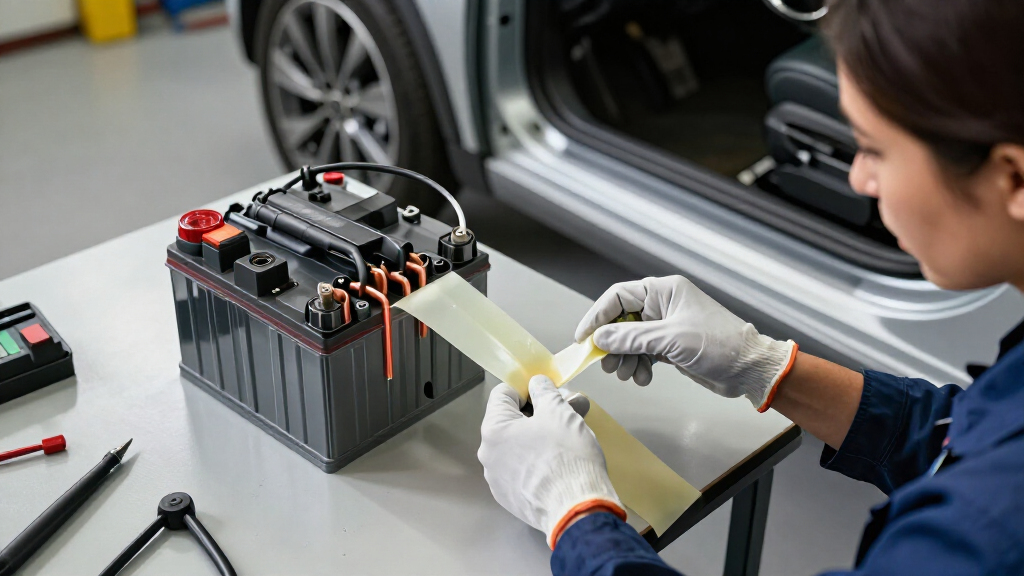
A Charged EVs report by Avery Dennison authors describes a three-part strategy using pressure-sensitive adhesive tapes to address heat transfer, cell-to-cell thermal runaway and vented gases or flames in battery packs. The material supplier presents product capabilities and performance comparisons, but the source does not report independent validation or adoption by a vehicle manufacturer.
A report by Avery Dennison authors Max VanRaaphorst and Avery Dennison outlines a three-part strategy for using pressure-sensitive adhesive (PSA) tapes in battery packs to manage heat transfer, isolate cells during thermal runaway and control vented gases and flames. The Charged EVs white paper describes potential applications and company product examples; it does not establish that the proposed approach has been independently validated or adopted in production vehicles.
The report frames battery thermal management as a growing engineering challenge as manufacturers pursue higher energy density and faster charging. In densely packed batteries, engineers must move heat from cells to cooling components while preserving electrical insulation. They also need barriers that can limit heat reaching neighboring cells and ways to manage hot gases, flames and particles released when a cell fails.
For heat transfer, the authors describe Avery Dennison’s Volt Tough tape line, which uses a dielectric film carrier and acrylic adhesive for bonding cells, modules and cooling components. The report compares dielectric PSA tape at 85 micrometres with thermosetting dielectric powder coatings typically around 250 micrometres. Assuming comparable thermal conductivity, it calculates about a 66% reduction in conductive thermal resistance for the thinner tape, and says heat could transfer nearly three times faster. These are figures and conclusions presented by the report, not independent test results included in the supplied material.
For cell isolation, the report proposes laminating low-thermal-conductivity tape with materials such as mica, aerogel or ceramic paper. The authors say the layered construction can combine insulation with mechanical strength and that some adhesives can withstand temperatures approaching 500°C for short periods. The third part addresses venting: the source names Avery Dennison anisotropic venting tapes as a way to manage gases and flames, but the provided report excerpt ends before explaining how they work or giving performance data.
Where Tape Fits in Pack Safety
The proposal addresses a practical design constraint: battery packs need to be compact, but their materials must still support cooling, electrical isolation and safe responses to cell failure. Thin, die-cuttable tapes that can be applied manually or on automated lines could offer manufacturers a way to add functions without introducing bulky parts or difficult assembly steps. The report also emphasizes that PSA products can be laminated to other materials, extending their possible use beyond adhesive bonding.
Thermal runaway can spread from a failing cell if heat, flames or vented material affect neighboring cells. Materials that slow heat transfer or direct venting could contribute to a pack’s safety design, but a tape is only one component in a broader system that includes cell design, cooling, pack structure, sensors and protective controls. The white paper describes a material strategy; it does not show that tape alone prevents runaway or guarantees containment.
pressure-sensitive adhesive tape for battery cooling
As an affiliate, we earn on qualifying purchases.
As an affiliate, we earn on qualifying purchases.
The Three Design Challenges
The report groups the engineering problem into three related tasks. First, a material must conduct heat toward a cooling surface while electrically isolating high-voltage components. Second, it must create a barrier between cells despite limited space. Third, pack designers must manage pressure and hot material discharged when a cell vents. The authors note that conventional insulating materials such as mica can be difficult to handle in automated production because they are fragile.
PSA tapes are presented as thin, customizable materials that can be cut to match pack geometry and applied with rapid assembly processes. The report lists other battery uses, including cell connections, wrapping, compression padding, gasketing, sealing and wire management. Its central argument is that combining tape adhesives with film or insulating substrates may address several design needs, though the appropriate material depends on the pack’s requirements.
“Engineers need a multifaceted thermal strategy that improves heat transfer, isolates components, contains runaway events and manages venting.”
— Max VanRaaphorst and Avery Dennison, report authors
thermal management PSA tapes for batteries
As an affiliate, we earn on qualifying purchases.
As an affiliate, we earn on qualifying purchases.
Evidence and Application Limits
The supplied source does not include independent test methods, full test results, or a comparison across specific battery chemistries, pack designs and operating conditions. It also does not identify automakers using the described products in production packs, quantify any reduction in thermal runaway incidents, or provide lifecycle data on durability after repeated exposure to heat, vibration and chemicals. The 66% resistance comparison is explicitly conditional on comparable thermal conductivity.
The excerpt cuts off while introducing anisotropic venting tapes, so their construction, vent direction, pressure limits and measured performance cannot be confirmed from the material provided. The report’s product claims and proposed benefits should be understood as supplier-authored information, not a regulatory finding or independent safety certification.
battery cell isolation adhesive tape
As an affiliate, we earn on qualifying purchases.
As an affiliate, we earn on qualifying purchases.
Validation Before Pack Adoption
The next step for pack developers would be to evaluate candidate tapes in the specific cell, module and cooling configurations for which they are intended. That work would need to test electrical insulation, heat transfer, adhesion, flame and gas behavior, and performance under relevant failure conditions, alongside production-line compatibility. The source gives no timetable for such testing, a regulatory review or commercial deployment.
Further details on the venting products and supporting test data would help readers assess the full three-part proposal. Until those details are available, the report establishes what Avery Dennison says its tape materials are designed to do, while leaving their performance in complete battery packs an open question.
venting tape for lithium-ion batteries
As an affiliate, we earn on qualifying purchases.
As an affiliate, we earn on qualifying purchases.
Key Questions
What does the report propose?
It proposes using PSA tapes to support heat transfer, thermal barriers and cell vent management in battery packs.
What is the reported 66% comparison based on?
The report compares 85-micrometre dielectric PSA tape with thermosetting dielectric powder coatings typically around 250 micrometres. The stated reduction in conductive thermal resistance assumes comparable thermal conductivity.
Does the report show that the tapes prevent thermal runaway?
No independent proof of prevention is included in the supplied material. The white paper presents a supplier-authored strategy and product claims, not evidence that tape alone prevents runaway or guarantees containment.
How are the tapes intended to help isolate cells?
The report describes laminating low-thermal-conductivity tape with mica, aerogel or ceramic paper to create an insulating barrier with added mechanical support.
What is known about the venting tapes?
The excerpt identifies Avery Dennison anisotropic venting tapes as part of the approach but ends before giving details about their operation or test performance.
Source: rss
Halloween Picks
halloween
As an affiliate, we earn on qualifying purchases.