
TL;DR

Get business pricing on garage and car supplies
- Business-only prices and quantity discounts
- Tax-exempt purchasing
- Multiple users, one account, clear invoices
Elonroad and three Singapore-based partners have signed an agreement to evaluate automatic conductive charging for electric heavy vehicles. The work will test how the technology can fit logistics operations; no results, deployment schedule or commercial rollout have been announced.
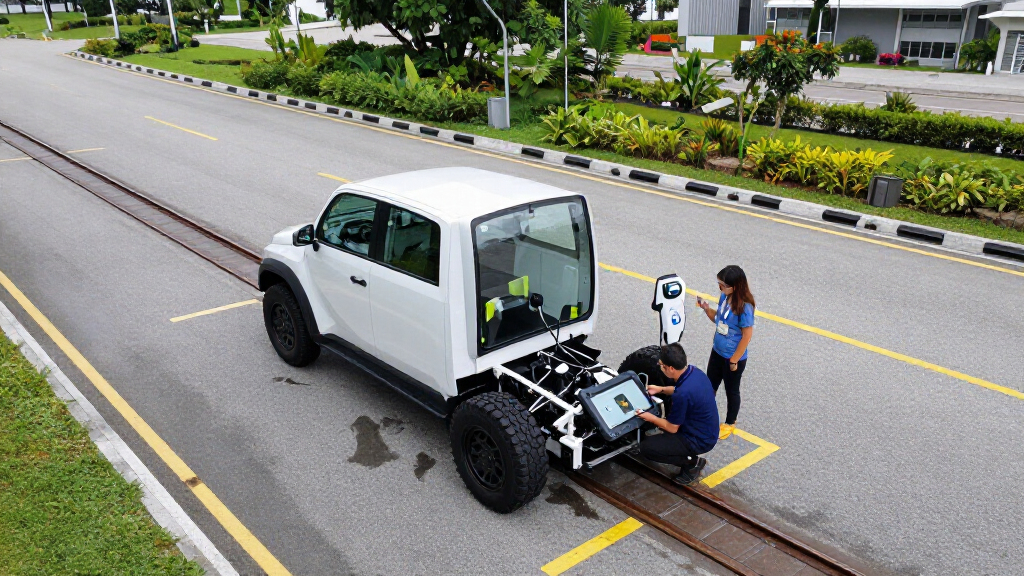
Elonroad, NTU Singapore’s Energy Research Institute (ERI@N), ALBA W&H Smart City and Scania have signed a memorandum of understanding to evaluate automatic conductive charging for electric heavy vehicles in Singapore. The collaboration will assess how Elonroad’s stationary, hands-free charging technology could be integrated into logistics operations, but the partners have not reported test results or a timetable for deployment.
The agreement is intended to bring the charging technology into an operational setting and examine its compatibility with electric heavy vehicles. The source report describes the system as automatic conductive stationary charging: vehicles would connect to charging equipment without a person manually plugging in a cable. It does not provide technical specifications for the equipment or explain the exact connection mechanism.
Each partner has a stated role. ERI@N will contribute research and compatibility testing; ALBA W&H Smart City will provide the operational environment for evaluation; and Scania will support installation on its vehicles. Elonroad is contributing its charging technology. The source does not identify particular vehicle models, sites, charging power or the number of vehicles involved.
The parties have signed an MOU to evaluate the system, rather than announcing a confirmed commercial service. The stated purpose is to test how automated charging could work within Singapore logistics operations. No performance data, costs, project milestones or commitments to expand the system were included in the report.
Testing Charging in Logistics Operations
For heavy-vehicle operators, charging is not only a matter of battery range: it must also fit vehicle schedules, site layouts and day-to-day operations. If automated stationary charging works reliably in the intended setting, it could reduce the need for drivers or staff to connect charging cables and may make charging easier to fit into operational routines. Those are potential benefits to be tested, not outcomes established by this announcement.
The collaboration also brings research, vehicle installation and an operating environment into one evaluation. That can help identify practical compatibility or workflow issues that a technology demonstration alone might not reveal. The project is relevant to Singapore’s transport electrification efforts, which ERI@N’s executive director cited as a goal, but the announcement does not quantify expected emissions reductions or say how many vehicles could be affected.
Products Worth Considering

Autel MaxiCharger AC Home Level 2 EV Charger, 50A, Hardwired J1772, Wi-Fi, 25-Foot Cable

DEWALT 20V MAX 1/4-Inch Impact Driver Kit with Battery and Charger (DCF787D1)

Vantrue N4S 3-Channel Dash Cam with STARVIS 2 Night Vision
As an affiliate, we earn on qualifying purchases.
Partners Combine Research and Operations
The project links a charging-technology company with a university research institute, a smart-city operations provider and a vehicle manufacturer. According to the source report, ERI@N brings EV charging research, testing and certification capabilities; ALBA W&H Smart City supplies an operational environment; and Scania supports installation on its vehicles. Their roles point to an evaluation focused on whether the system can be tested with vehicles and logistics activity, not just in a laboratory.
Elonroad CEO Karin Ebbinghaus described the partnership as bringing research, technology and everyday operations together. ERI@N Executive Director Professor Madhavi Srinivasan said academic-industry partnerships can help translate research into real-world solutions. These statements describe the partners’ aims; they do not confirm that the charging system has already met performance or certification requirements in Singapore.
““The next chapter of transport will be electric and increasingly autonomous.””
— Karin Ebbinghaus, CEO of Elonroad
Test Scope and Results Are Pending
The announcement does not specify when testing will begin or end, where the evaluation will take place, or how many vehicles and charging units will be involved. It also gives no information about charging speed, system performance, reliability, vehicle compatibility beyond Scania’s support for installation, or the standards against which the equipment will be assessed.
It remains unclear whether the evaluation will lead to a pilot, a commercial deployment or further testing. The partners have not announced costs, operating results, emissions impacts or a decision to scale the system. Until those details emerge, the agreement should be understood as a plan to evaluate the technology, not evidence of a completed rollout.
Evaluation Details to Follow
The next step described by the partners is to evaluate the system in a logistics operating environment, with ERI@N conducting research and compatibility testing and Scania supporting vehicle installation. No dates or public reporting milestones have been announced, so the timing of practical trials and any findings is unknown.
Readers should look for updates on the test location, participating vehicles, charging performance and whether the partners decide to proceed beyond evaluation. Those details will show whether automatic conductive charging can meet the operational requirements of heavy-vehicle logistics in Singapore.
Key Questions
What are the partners testing?
They plan to evaluate Elonroad’s automatic conductive stationary charging for electric heavy vehicles and assess how it could fit Singapore logistics operations.
Which organizations are involved?
The partners are Elonroad, NTU Singapore’s Energy Research Institute (ERI@N), ALBA W&H Smart City and Scania.
Has the system been deployed commercially?
The announcement describes an MOU to evaluate the technology. It does not confirm a commercial deployment or an operating service.
When will testing begin?
The source report does not give a start date, duration or schedule for the evaluation.
What results have been reported so far?
No test results, performance figures, cost estimates or emissions data have been reported in the source material.
Source: chargedevs.com