
TL;DR

Get business pricing on garage and car supplies
- Business-only prices and quantity discounts
- Tax-exempt purchasing
- Multiple users, one account, clear invoices
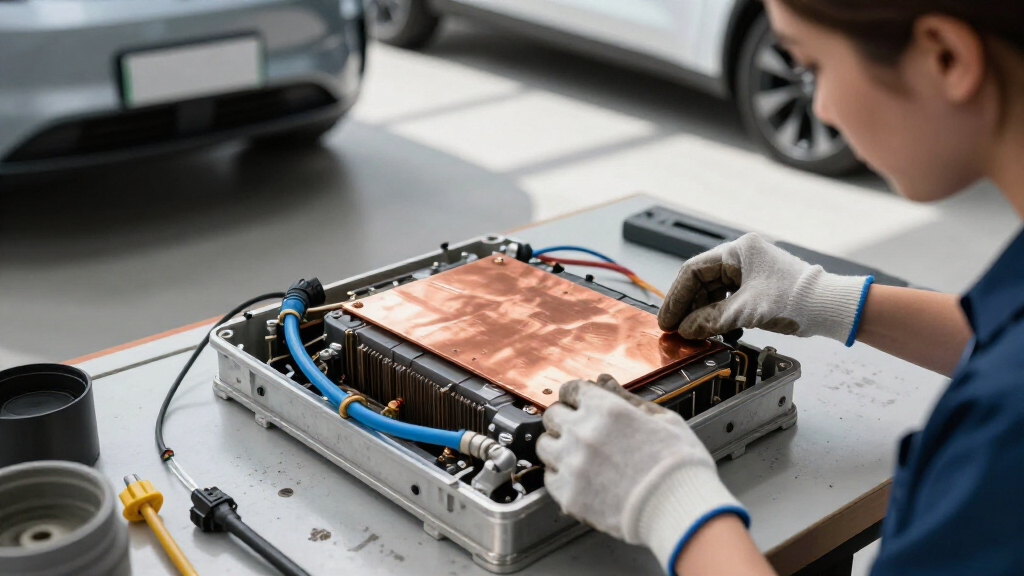
A sponsored report published by Charged EVs describes how structural flame-retardant foams, adhesives and sealants are being used to address heat and safety challenges in cell-to-pack and cell-to-chassis EV batteries. It outlines potential material functions, but provides no comparative test results or evidence that a particular design prevents thermal runaway.
A sponsored report published by Charged EVs describes how flame-retardant foams, adhesives and sealants can help manage heat and support safety as automakers move toward cell-to-pack and cell-to-chassis battery designs. The report, sponsored by materials supplier H.B. Fuller, presents these materials as part of a broader design response to higher energy density, while offering no product-specific test data in the supplied material.
Traditional EV battery packs commonly group cells into modules, then assemble the modules into a pack. The report says newer cell-to-pack designs remove module housings, while cell-to-chassis approaches integrate cells into the vehicle’s structure. These configurations can reduce weight and free space for active cell material, but they also increase demands on the materials that secure and protect the battery.
According to the report, battery materials may need to provide structural support, electrical isolation and thermal protection at the same time. Heat generated during charging and operation can contribute to degradation and efficiency losses; in severe cases, a cell failure can trigger thermal runaway. The report argues that closer cell spacing and higher power demands make managing heat an increasingly central part of pack design.
Structural flame-retardant foams are described as serving several roles: replacing some heavier supports, reinforcing assemblies, limiting vibration and helping slow heat transfer between cells. Adhesives and encapsulation materials may also contribute to structural integrity and thermal management. The report cites UL 94 V-0 as a flammability benchmark, but a material rating alone does not establish how a complete battery pack will behave in a thermal event.
Materials Carry More Battery Functions
The shift toward more integrated battery structures changes the trade-offs facing automakers. Removing module casings can save weight and packaging space, but it leaves fewer separate components between cells and the vehicle structure. Materials used to bond, insulate and reinforce the assembly may therefore influence not only manufacturing and vehicle mass, but also how heat and mechanical loads move through the pack.
For readers, the key point is that battery safety and performance depend on more than cell chemistry. Design choices and materials can affect heat management, durability and failure containment. The report makes a case for considering those materials earlier in pack design; it does not establish that foam or adhesive use alone guarantees safety, longer range or faster charging.
EV battery thermal management foam
As an affiliate, we earn on qualifying purchases.
As an affiliate, we earn on qualifying purchases.
From Modules to Integrated Packs
In a cell-to-module architecture, modules provide intermediate housings that can make individual sections easier to replace, although they add components and occupy space. Cell-to-pack designs reduce that packaging layer by placing cells directly in the pack. Cell-to-chassis designs take integration further by making the battery part of the vehicle’s structure. The report presents this progression as a response to automakers’ goals of more range, lower weight and reduced manufacturing complexity.
The source is a supplier-sponsored report, not an independent comparison of battery architectures or material products. Its discussion covers EVs as well as potential applications in stationary energy storage, commercial vehicles and other electric equipment. The supplied text does not identify a new product launch, a specific automaker adoption, or a dated policy change.
“Achieving those objectives requires more than advances in cell chemistry alone.”
— Charged EVs report sponsored by H.B. Fuller
flame-retardant adhesives for EV batteries
As an affiliate, we earn on qualifying purchases.
As an affiliate, we earn on qualifying purchases.
Performance Evidence Is Not Provided
The supplied report does not provide comparative test results, named battery programs or product-specific data showing how much weight a foam replaces, how effectively it limits heat propagation, or how performance changes under real-world use. It also does not specify the test conditions behind the material examples or compare them with alternative thermal-management approaches.
The report describes a UL 94 V-0 rating as indicating rapid self-extinguishing behavior in a flammability test. That rating should not be read as proof that a complete battery pack will contain thermal runaway. Pack-level outcomes depend on cell design, spacing, cooling, barriers, electrical controls and other factors; the source does not quantify their combined effects.
thermal insulation sealants for electric vehicle batteries
As an affiliate, we earn on qualifying purchases.
As an affiliate, we earn on qualifying purchases.
Pack-Level Testing Will Matter
The report does not announce a specific next milestone or provide a schedule for a product, regulation or automaker program. The practical next step for evaluating its claims is pack-level testing and disclosure that identify test methods, operating conditions and comparison baselines. That evidence would help manufacturers judge whether a material meets structural and thermal requirements in a given battery architecture.
As cell-to-pack and cell-to-chassis designs develop, automakers and suppliers will need to show how materials perform together with cooling systems and safety controls, rather than relying on a single flammability rating. The report’s discussion points to that design challenge, but specific adoption and measured benefits remain unconfirmed in the material provided.
battery pack structural support materials
As an affiliate, we earn on qualifying purchases.
As an affiliate, we earn on qualifying purchases.
Key Questions
What is the report’s main development?
It describes how foams, adhesives and sealants may support thermal management and structural performance in newer EV battery designs. It is a sponsored report, not an announcement of a particular vehicle or battery launch.
How do cell-to-pack and cell-to-chassis designs differ?
Cell-to-pack designs place cells directly in the battery pack rather than grouping them in separate modules. Cell-to-chassis designs integrate the battery more directly into the vehicle structure.
Does a UL 94 V-0 rating prove a battery pack is safe?
No. The report cites V-0 as a material flammability benchmark. It does not by itself show how an entire battery pack will respond to thermal runaway.
Does the report give evidence of improved range or safety?
It describes potential benefits, including lower weight and reduced thermal propagation, but the supplied text gives no comparative measurements establishing a specific range gain or safety improvement.
Source: rss
Halloween Picks
halloween
As an affiliate, we earn on qualifying purchases.