TL;DR

Get business pricing on garage and car supplies
- Business-only prices and quantity discounts
- Tax-exempt purchasing
- Multiple users, one account, clear invoices
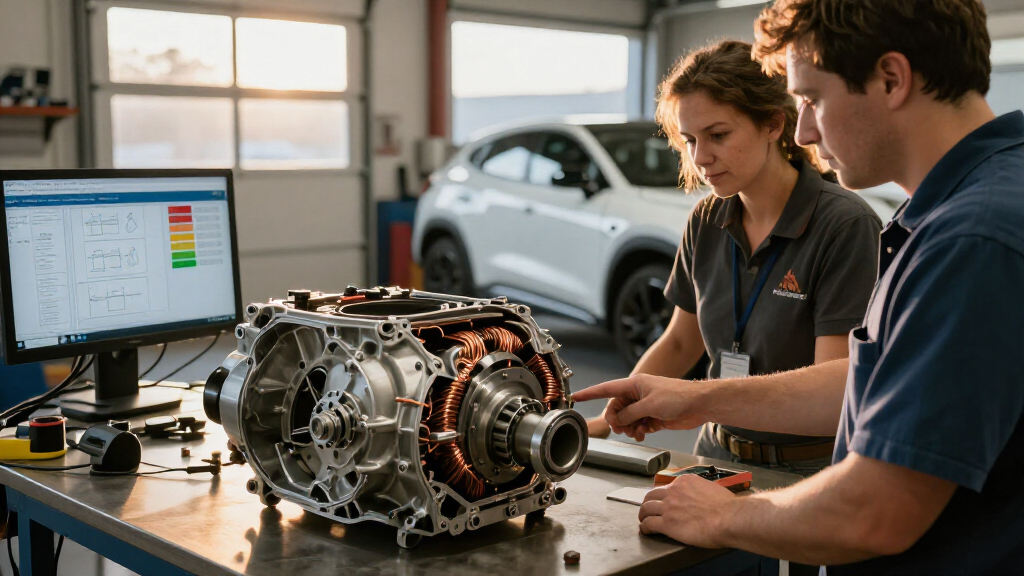
Researchers at Oak Ridge National Laboratory developed Motor Decide, a platform that ranks electric motor technology options for specific applications. It weighs factors including critical-material availability, supply-chain stability, performance, cost and technology maturity, and can test scenarios such as sharp copper price increases.
Researchers at the U.S. Department of Energy’s Oak Ridge National Laboratory have developed Motor Decide, a platform that ranks electric motor technology options against material availability, supply-chain stability, performance and other factors. The tool is intended to help manufacturers choose an approach for a specific application while accounting for uncertainty around critical materials and future market conditions.
Motor Decide evaluates options using factors that include critical-material availability, technology maturity, manufacturability, cost, performance and long-term resilience. ORNL’s description says the platform does not design a motor; it helps users assess which motor technology may be the best fit for their needs. Its output is a ranked set of options with information about trade-offs and risks.
The system combines what ORNL calls super intelligence (SI) with modeling and large-scale scenario analysis. Researchers can explore how choices might fare under changing conditions, such as a sharp rise in copper prices or the later commercial availability of a newer technology. The source describes these as scenarios for analysis, not forecasts or guaranteed outcomes.
Motor Decide is designed to work alongside ORNL’s Motor AI platform, which uses SI-assisted engineering tools to support detailed motor design. After a company selects a technology approach using Motor Decide, researchers can transfer the results into Motor AI to generate design configurations and engineering specifications, according to the source report.
How Material Risk Shapes Motor Choices
Electric-motor manufacturers must weigh more than a design’s performance. Dependence on materials such as copper and rare earth elements can expose production plans to changing prices and supply disruptions. A tool that compares technologies across those factors could help companies examine the risks attached to an option before committing to detailed engineering or manufacturing plans.
Motor Decide’s stated purpose is to make those trade-offs visible in a structured comparison. That could be useful when a technology appears attractive on current performance or market momentum but carries different material, maturity or supply-chain risks. ORNL says the platform is intended to support long-term, data-informed decisions; the source does not provide evidence yet of commercial results, cost savings or improved supply resilience from its use.
Products Worth Considering

DEWALT 20V MAX Cordless 1/2-Inch Impact Wrench Kit (DCF900P1)

Vantrue N4 Pro S 4K 3-Channel Dash Cam with Triple STARVIS 2 HDR

DEWALT 20V MAX Drill and Impact Driver (DCK277D2)
As an affiliate, we earn on qualifying purchases.
From Technology Screening to Design
Motor Decide addresses an earlier step in motor development than detailed engineering. It compares technology approaches for a defined application, while Motor AI supports work on detailed designs after an approach is selected. ORNL describes the two platforms as complementary, with results from the decision tool able to feed into the design workflow.
The source report says many electric motors use critical minerals, including copper and rare earth elements, and frames uncertainty in their availability and price as a factor manufacturers need to assess. It does not identify particular motor technologies that the platform ranks, name a specific manufacturer using it, or report a completed case study. The available description is about the tool’s intended functions and analytical process.
“Many companies make technology decisions based largely on market momentum or competitor activity.”
— Praveen Kumar, lead researcher on the project
Questions About Access and Validation
The source material does not say whether Motor Decide is publicly available, which manufacturers or applications are currently using it, or what data users must provide. It also does not specify the motor technologies included in its comparisons, the assumptions behind its scenario models, or how the platform’s rankings are validated against real-world outcomes.
No quantitative results are provided for accuracy, time savings, cost reductions or supply-chain risk. The copper-price and future-technology examples illustrate scenarios the tool can model; they are not predictions. It is also not clear whether the platform incorporates live prices or supplier information, or how often its inputs are updated.
Further Details on Use and Testing
The source report does not announce a release date, deployment schedule or next public milestone for Motor Decide. Further information from ORNL would be needed to establish how manufacturers can access the tool, what applications it supports and whether any industrial partners have tested it.
Practical evidence would include documented comparisons for specific motor applications, descriptions of the assumptions and data used, and results showing how rankings change under different material-price or supply conditions. If the workflow is used as described, a selected technology approach could then move from Motor Decide’s comparison stage to detailed configurations generated with Motor AI.
Key Questions
What is ORNL’s Motor Decide?
Motor Decide is a platform developed by Oak Ridge National Laboratory researchers to compare and rank electric motor technology options for a particular application. It considers material, supply-chain, performance and other factors.
Does Motor Decide design electric motors?
No. The source says the platform evaluates technology options rather than designing a motor. ORNL’s Motor AI platform is intended to support detailed design work after a technology approach is selected.
What factors does the platform assess?
ORNL says the assessment includes critical-material availability, supply-chain stability, performance, cost, manufacturability, technology maturity and long-term resilience.
Can the tool predict future material prices?
The described function is scenario analysis, not a confirmed price forecast. Researchers can examine cases such as a sharp copper-price increase, but the source does not say Motor Decide predicts prices or guarantees future outcomes.
Is Motor Decide available to manufacturers now?
The source material does not state whether the platform is publicly available, how companies can access it or whether manufacturers are already using it.
Source: chargedevs.com