
TL;DR

Get business pricing on garage and car supplies
- Business-only prices and quantity discounts
- Tax-exempt purchasing
- Multiple users, one account, clear invoices
Mercedes-Benz has presented a concept for projecting digital images onto specially laminated windshield glass, including navigation, points of interest and video. The system is under consideration for future production models; Mercedes has not confirmed a vehicle, release date or final features.
Mercedes-Benz is considering a system that projects digital images onto a specially treated windshield, the automaker said while presenting technologies it may use in future production models. The concept could put items such as navigation directions, points of interest and video within the windshield area, but Mercedes has not said whether or when the feature will reach a production car.
According to Mercedes-Benz’s description, a projector built into the dashboard would send light toward windshield glass laminated with what the company calls “holographic optical elements.” The elements selectively reflect certain wavelengths from the projector to form images. Mercedes says the projection is concentrated so it can remain visible in direct sunlight.
The company also says the display can be made visible from selected viewing angles. That could allow a passenger to see content on one part of the windshield without the driver seeing it, or the reverse. Mercedes has not published detailed specifications or explained how the system would be controlled while the car is moving.
Unlike a physical display attached to the glass, the proposed system uses projection, so no image is permanently fixed on the windshield. The glass could remain clear when the feature is not being used, according to the description. Mercedes also presented separate LED-projection technology for displaying warning messages in a vehicle’s rear window, as well as a power converter intended to manage current flow at the cell level in EV battery packs.
A Larger Display, With Safety Questions
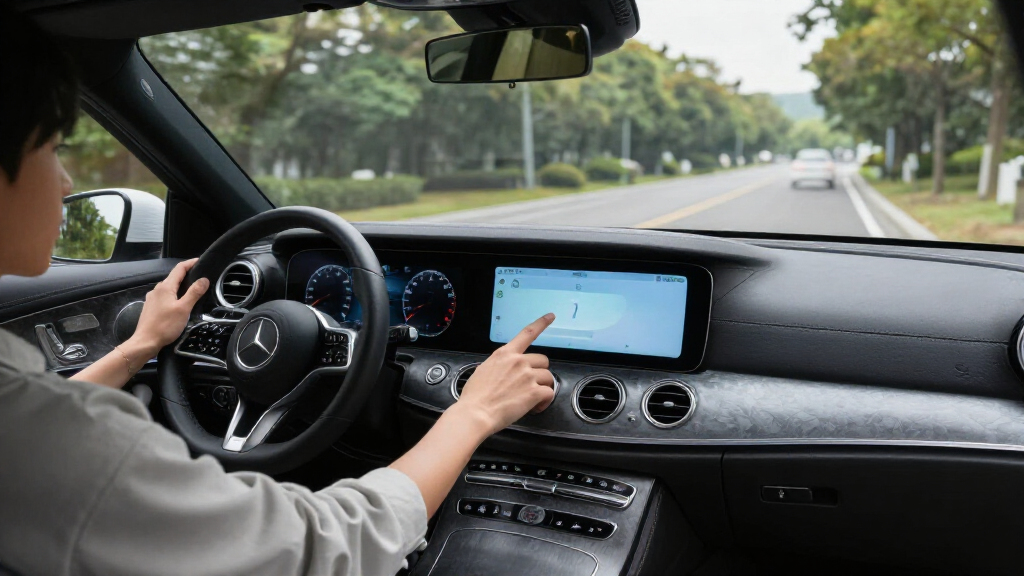
The concept points to another possible expansion of in-car screens, extending digital information from the dashboard into a surface that is already central to a driver’s view. For passengers, angle-selective projections could offer a way to watch or read content without showing the same material to the driver. For automakers, the approach may add display area without installing a conventional screen over the glass.
That possibility also puts driver attention and visibility at the center of the debate. A projected image may disappear when switched off, but that does not resolve whether displaying navigation, alerts or entertainment across a windshield could distract drivers or compete with the road scene. Mercedes has not detailed operating limits, safety testing or rules for which information could appear while driving. Those issues will matter as much as image quality if the technology advances.
Products Worth Considering

Autel MaxiSYS MS906 MAX Automotive Diagnostic Scanner, 10.1-Inch

Autel MaxiCOM MK808BT PRO Bidirectional OBD2 Diagnostic Scanner

Chemical Guys 14-Piece Arsenal Builder Car Wash Kit with Foam Blaster
As an affiliate, we earn on qualifying purchases.
Other Companies Have Explored Windshield Displays
The idea is related to existing head-up displays, which project limited driving information into a driver’s line of sight. Mercedes’ proposal describes a broader projected image area and content that could include material for passengers. The source report also notes that the system is not unique as a concept: Nissan design chief Alfonso Albaisa told The Drive in a 2024 interview that he expected the windshield to become a screen, while Apple filed a patent application for similar technology in 2023.
Those examples establish that companies have considered windshield-based displays, not that a comparable full-windshield system is ready for broad sale. Mercedes already markets large dashboard display systems, including its Hyperscreen and Superscreen. The new proposal would shift some digital content from dashboard panels to the windshield, but the automaker has not said it will replace or supplement those systems in a specific model.
““holographic optical elements””
— Mercedes-Benz, in its description of the proposed system
Production Plans and Safety Details
No production model, launch date or price has been announced for Mercedes’ projected windshield display. The company has not said whether it is a working vehicle-ready system, a development concept or a feature still undergoing evaluation. Its public description does not specify the image area, resolution, brightness under different conditions, passenger controls or how the projection would be limited while driving.
It is also unclear what content would be available to drivers and passengers, whether video would be restricted when the car is moving, or how the system would comply with applicable safety requirements. Mercedes’ statement that images can be separated by viewing angle describes a capability the company says the technology offers; it does not establish how reliably that separation works in real-world driving conditions.
Awaiting a Vehicle and Safety Details
The next concrete milestone would be a Mercedes announcement identifying a production application, testing program or development timeline. Until then, the windshield display should be treated as a technology the automaker is considering, rather than a confirmed feature customers can expect in a named model.
Further information from Mercedes would be needed to assess how the display behaves in daylight, whether it can be disabled quickly and which functions remain available while driving. The company’s other announced technologies, including the rear-window warning projection and EV power converter, also lack production timing in the material provided.
Key Questions
Has Mercedes confirmed that the windshield display will go into production?
No. Mercedes has described the technology as something it is considering for future production models, but has not named a vehicle or confirmed a launch.
How would the projected windshield display work?
A dashboard-mounted projector would send light to specially laminated glass containing holographic optical elements, which selectively reflect light to form images, according to Mercedes.
What could appear on the windshield?
Mercedes has cited points of interest, navigation and videos. It has not explained which content would be available in different driving situations.
Could the driver and passenger see different images?
Mercedes says the system can control visibility by viewing angle, potentially allowing the passenger to see content that is not visible to the driver. Real-world performance details have not been provided.
When might the technology be available?
No timing has been announced. Mercedes has not provided a production schedule, price or model assignment.
Source: thedrive.com